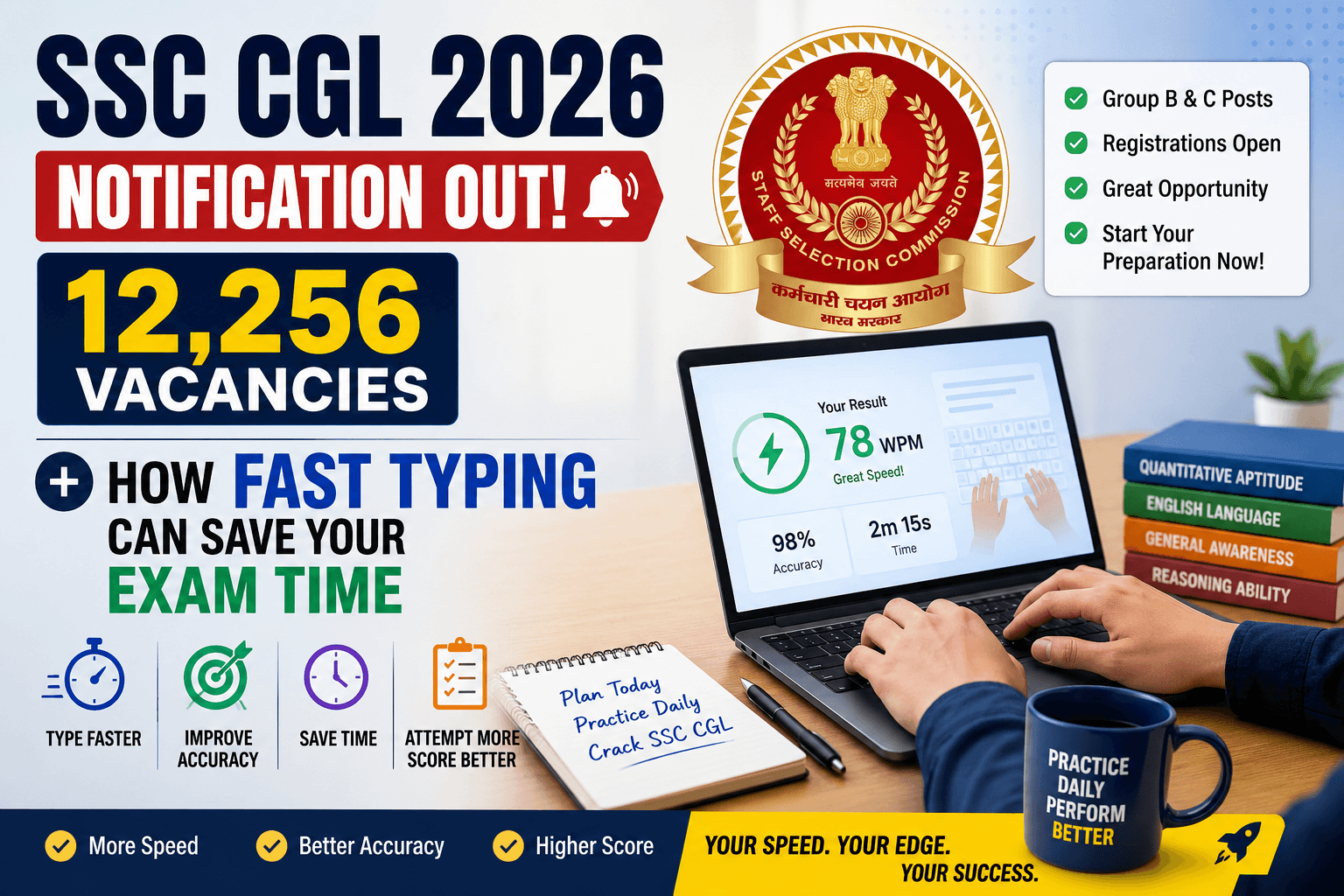
If you're preparing for SSC CHSL or any other government exam that includes a typing test, you already know the pressure. The clock is ticking, your fingers are fumbling, and 35 WPM just isn't going to cut it. The good news? Getting to 80 WPM is absolutely doable — and you don't need to be a computer wizard to get there.
Thousands of SSC aspirants make this jump every year. The difference between those who clear the typing test and those who don't usually comes down to a few key habits. Let's break them all down.
Understand What SSC Actually Expects From You
Before you start grinding, it helps to know your target. The SSC CHSL typing test requires a minimum speed of **35 WPM for English** and **30 WPM for Hindi** (in terms of key depressions, that's around 10,500 KPH for English). But here's the thing — just scraping by at the minimum is risky. Errors count against you, and on exam day, nerves can slow you down by 10–15 WPM easily.
That's why serious aspirants aim for 75–85 WPM in practice. If you can comfortably type at 80 WPM during training, hitting 65–70 WPM under exam pressure becomes very achievable. Set your bar higher than the requirement, and you'll thank yourself later.
Ditch the Hunt-and-Peck Style Immediately
This is probably the single biggest habit holding most aspirants back. If you're still looking at the keyboard while you type, you're essentially putting a speed limit on yourself. No matter how fast your eyes are, hunting for keys will always be slower than muscle memory.
Touch typing — where all ten fingers are assigned specific keys and you never look down — is the foundation of fast, accurate typing. Yes, it feels painfully slow in the beginning. Your speed might even drop from 35 WPM to 20 WPM for the first week. Push through it. That temporary slowdown is an investment that pays off massively within 3–4 weeks.
Start with the home row keys (ASDF for the left hand, JKL; for the right). Get comfortable there before moving to upper and lower rows. Free platforms like **TypingMonk** let you practice structured lessons that follow exactly this kind of progressive approach.
Practice in Short, Focused Sessions — Not Marathon Runs
Here's a mistake a lot of aspirants make: they sit down for two-hour typing sessions and expect rapid improvement. The reality is that your fingers and brain learn better in shorter, focused bursts.
Aim for **20–30 minute practice sessions, twice a day**. In the morning, do a warm-up with basic drills. In the evening, take a full timed test to track your progress. This approach keeps you fresh, reduces fatigue-related errors, and helps build consistent muscle memory rather than sloppy speed.
Consistency beats intensity every single time. Thirty minutes a day for 60 days will take you much further than five hours on a Sunday followed by nothing for the rest of the week.
Target Your Weak Keys, Not Just Your Overall WPM
Most people practice full passages and hope their speed goes up. Smart aspirants do something different — they identify the specific keys or key combinations that slow them down and drill those deliberately.
For example, a lot of people struggle with: - Keys typed by the weakest fingers (Q, Z, P, semicolons) - Capital letters that require the Shift key - Number row keys - Common letter combos like "th", "ing", "tion"
Take a few practice tests and pay attention to where your rhythm breaks. Those are your problem spots. Spend 5–10 minutes at the start of each session just hammering those specific characters. TypingMonk's practice modes let you customize exactly this kind of targeted drilling, which makes the whole process a lot more efficient.
Don't Chase Speed — Chase Accuracy First
This sounds counterintuitive, but it's one of the most important mindset shifts you can make. Typing fast with lots of errors is actually slower than typing moderately fast with high accuracy — especially in SSC exams where mistakes lead to penalty deductions.
Aim for **95%+ accuracy before you try to push your speed**. When accuracy is locked in, speed will follow naturally as your muscle memory gets stronger. If you're constantly backspacing and correcting errors, you're reinforcing bad habits and your actual effective WPM stays low.
A useful rule: if your accuracy drops below 92% during a practice session, slow down. Deliberately. Type slower until accuracy climbs back up, then gradually increase pace.
Use Real Exam-Style Text for Practice
Practicing with random internet memes or casual chat language won't fully prepare you for the SSC typing test. The passages used in SSC exams tend to have formal language, longer words, and specific vocabulary. Your fingers need to be comfortable with that kind of content.
Look for SSC typing test sample passages online and practice specifically with those. Websites like TypingMonk also offer typing tests with varied content difficulty, which helps you get comfortable with both everyday words and more complex formal vocabulary.
Track Your Progress — Seriously, Write It Down
Progress in typing can feel invisible, especially in the early weeks. One of the best ways to stay motivated is to actually track your WPM and accuracy every single day. Keep a simple notebook or spreadsheet. Note down your speed and accuracy after each practice session.
When you look back after three weeks and see that you've gone from 35 WPM to 52 WPM, that's a massive motivational boost. It also helps you notice patterns — like maybe your morning sessions are faster than evening ones, or your accuracy drops after 20 minutes of practice. Data helps you practice smarter.
A Realistic Timeline to 80 WPM
Here's what a realistic journey might look like for a dedicated SSC aspirant starting at 35 WPM:
- **Week 1–2:** Learn proper touch typing technique. Speed may temporarily drop. Focus only on accuracy and finger placement. - **Week 3–4:** Speed starts climbing back to 35–40 WPM with better technique. - **Week 5–8:** Consistent practice pushes you into the 50–60 WPM range. - **Week 9–12:** Targeted drills and daily tests get you to 70–80 WPM.
Three months of consistent effort. That's genuinely all it takes for most people.
Final Thoughts
Going from 35 WPM to 80 WPM isn't magic — it's just about building the right habits and sticking to them. Touch typing, focused practice, accuracy-first mindset, and daily tracking will take you further than any shortcut ever could.
SSC exams are competitive, but the typing test is one section where hard work directly and predictably pays off. Start today, be consistent, and 80 WPM will feel surprisingly natural before your exam date arrives. You've got this.
Put it into practice
Take a free typing test and see your WPM right now.
Comments
Sign in to leave a comment.