Every few years, a new technology arrives promising to make the keyboard obsolete. First it was touchscreens, then swipe typing, and now — Voice AI. With tools like ChatGPT, Copilot, and Gemini becoming deeply embedded in daily workflows, it's fair to ask: is learning to type fast still worth your time in 2026?
The short answer is a resounding yes. But the longer answer reveals something fascinating about how humans communicate, work, and think — and why the keyboard isn't going anywhere just yet.
The Rise of Voice AI: What's Actually Changed
Voice recognition technology has made extraordinary leaps in the past decade. Modern AI-powered speech tools can transcribe spoken words with near-perfect accuracy, understand context, and even interpret intent. Platforms like Apple's Dictation, Google's voice input, and dedicated tools like Whisper by OpenAI have made speaking to your computer genuinely practical for the first time.
In 2026, millions of people use voice input daily for composing emails, drafting documents, and interacting with AI assistants. The technology is fast, increasingly affordable, and impressively accurate across multiple languages and accents.
So why hasn't typing disappeared?
The Limits of Voice Input You Don't Hear About
Voice AI is powerful, but it comes with a set of real-world limitations that make it unsuitable as a complete replacement for keyboard-based communication.
**Privacy and environment constraints** are among the biggest hurdles. Open-plan offices, coffee shops, libraries, public transit — a significant portion of modern work happens in environments where talking to your device is impractical, disruptive, or simply inappropriate. Typing remains the silent, socially acceptable default in shared spaces.
**Precision and editing** present another challenge. While voice AI transcribes speech well, editing that transcription requires returning to — you guessed it — a keyboard. Navigating, correcting, restructuring, and formatting text through voice commands alone remains cumbersome compared to a skilled typist who can precisely place a cursor, select a phrase, and retype in seconds.
**Complex technical work** is another area where voice falls short. Developers writing code, data analysts building formulas, or designers using keyboard shortcuts all rely on a level of tactile precision that voice simply cannot replicate. Try dictating a Python function or a complex spreadsheet formula and you'll quickly appreciate why programmers still swear by their mechanical keyboards.
Typing Speed Is a Direct Productivity Multiplier
Here's something worth internalizing: your typing speed is directly tied to how fast your thoughts become output in the world. The average person types around 40 words per minute. A skilled typist hitting 80–100 WPM produces work at twice the rate. Over a full workday, that gap is enormous.
For knowledge workers — writers, marketers, analysts, developers, educators — the keyboard is still the primary interface between their minds and their output. Even when using AI tools, the quality of your prompts, the speed at which you refine responses, and your ability to rapidly edit AI-generated content all depend on typing fluency.
Fast, accurate typing doesn't just save time. It reduces cognitive friction. When your fingers can keep pace with your thoughts, your ideas flow more naturally. You spend less mental energy on the mechanics of input and more on the quality of your thinking.
Voice and Typing: A Complementary Future
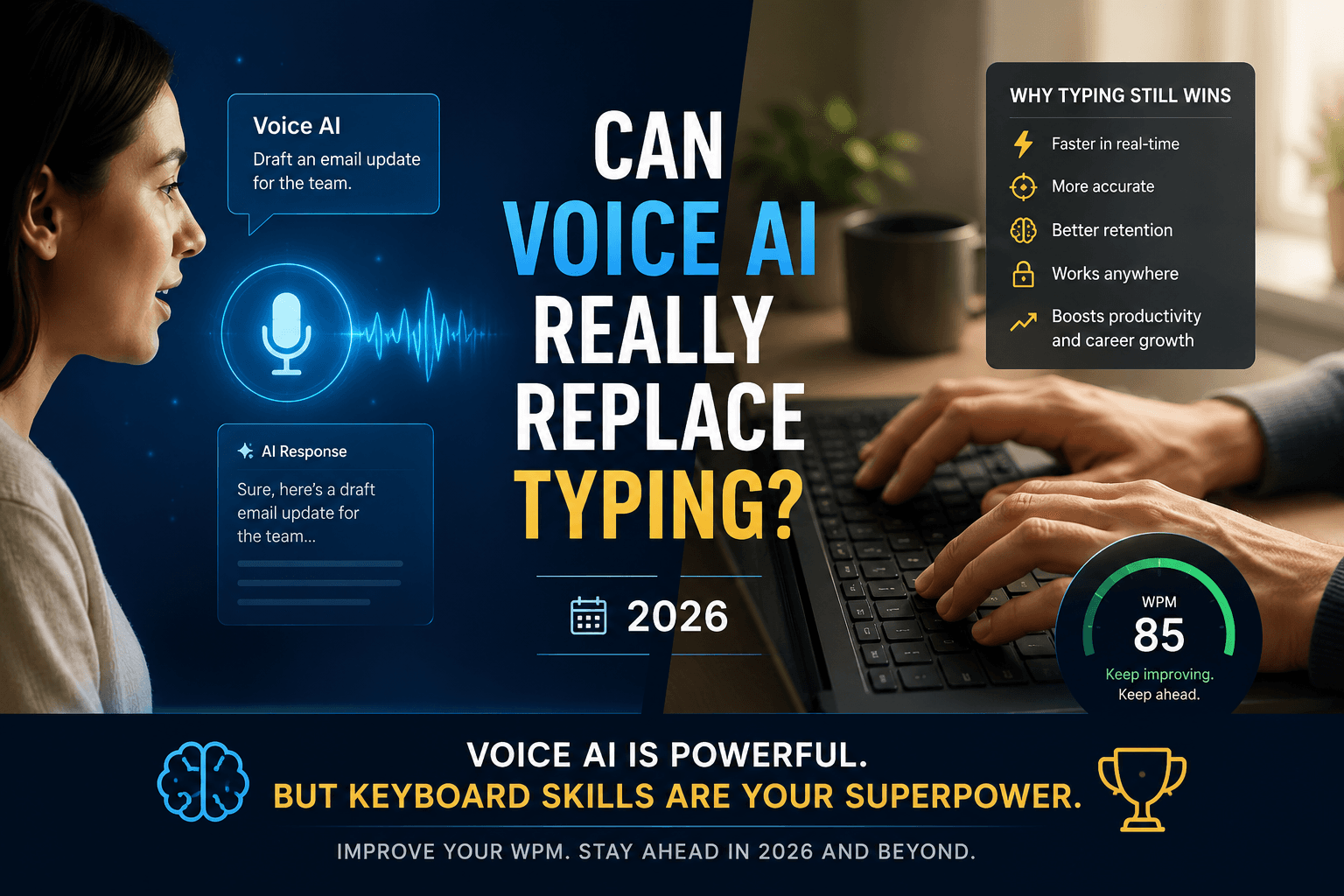
The most productive professionals in 2026 aren't choosing between voice and typing — they're using both strategically. Voice AI handles dictation during commutes, brainstorming sessions, and hands-free moments. The keyboard takes over for precise editing, coding, messaging, and any situation where silence is preferred or required.
Think of it like driving with GPS navigation. GPS didn't eliminate the need to understand how to drive — it enhanced the driving experience. Similarly, Voice AI enhances communication workflows, but it doesn't replace the foundational skill underneath.
In fact, as AI assistants become more embedded in daily tools, being able to type quickly and accurately to interact with them becomes even more valuable. Crafting better prompts, iterating faster, and editing AI output efficiently are all keyboard-dependent skills.
Keyboard Skills in Education and the Workplace
Despite the rise of voice interfaces, keyboard proficiency continues to be treated as a core competency in education and hiring. Standardized testing in many countries is conducted on keyboards. Job listings across industries still list typing speed as a preferred or required skill. Remote work — still dominant in 2026 — depends heavily on written communication through messaging platforms like Slack, email, and collaborative documents.
Students who develop strong typing skills early consistently perform better in digital learning environments. They complete assignments faster, take more thorough notes, and participate more actively in online discussions. The investment in learning to type well pays dividends across every academic subject and career path.
How to Future-Proof Your Typing Skills
If you're convinced that typing still matters — and it does — the good news is that improving your WPM is one of the most measurable, achievable skill upgrades you can make. Unlike many professional skills that require expensive courses or years of practice, meaningful typing improvements can happen in weeks with consistent, focused effort.
Here's how to approach it:
**Start with proper technique.** Home row positioning, correct finger placement, and not looking at the keyboard form the foundation of fast, accurate typing. Bad habits are hard to unlearn, so getting fundamentals right from the beginning saves time in the long run.
**Practice consistently in short sessions.** Research on skill acquisition consistently shows that 15–20 minutes of focused daily practice outperforms occasional marathon sessions. Regular repetition builds muscle memory more effectively than infrequent bursts.
**Use a typing speed test platform.** Tools like TypingMonk let you measure your current WPM, track progress over time, and practice with real-world texts that build both speed and accuracy simultaneously. Seeing your numbers improve is a powerful motivator.
**Target accuracy before speed.** It's tempting to race, but accuracy-first training produces faster long-term gains. Precision at lower speeds builds the muscle memory needed to type both fast and correctly at higher speeds.
The Keyboard Endures
Voice AI is an impressive, genuinely useful technology — and it will continue to evolve. But the keyboard has survived the typewriter, the touchscreen, and the stylus. It will survive Voice AI too, because it solves problems that voice simply cannot.
In a world increasingly mediated by AI tools, the ability to type quickly and accurately is not a relic of the past. It's a competitive advantage in the present and a durable skill for the future. The professionals who thrive won't be those who abandoned the keyboard — they'll be those who mastered it.
So whether you're a student, a developer, a writer, or a remote worker, there has never been a better time to invest in your typing speed. Start where you are, track your progress, and watch how quickly the words — and the results — follow.
Put it into practice
Take a free typing test and see your WPM right now.
Comments
Sign in to leave a comment.