What Is CPCT and Why Does It Matter?
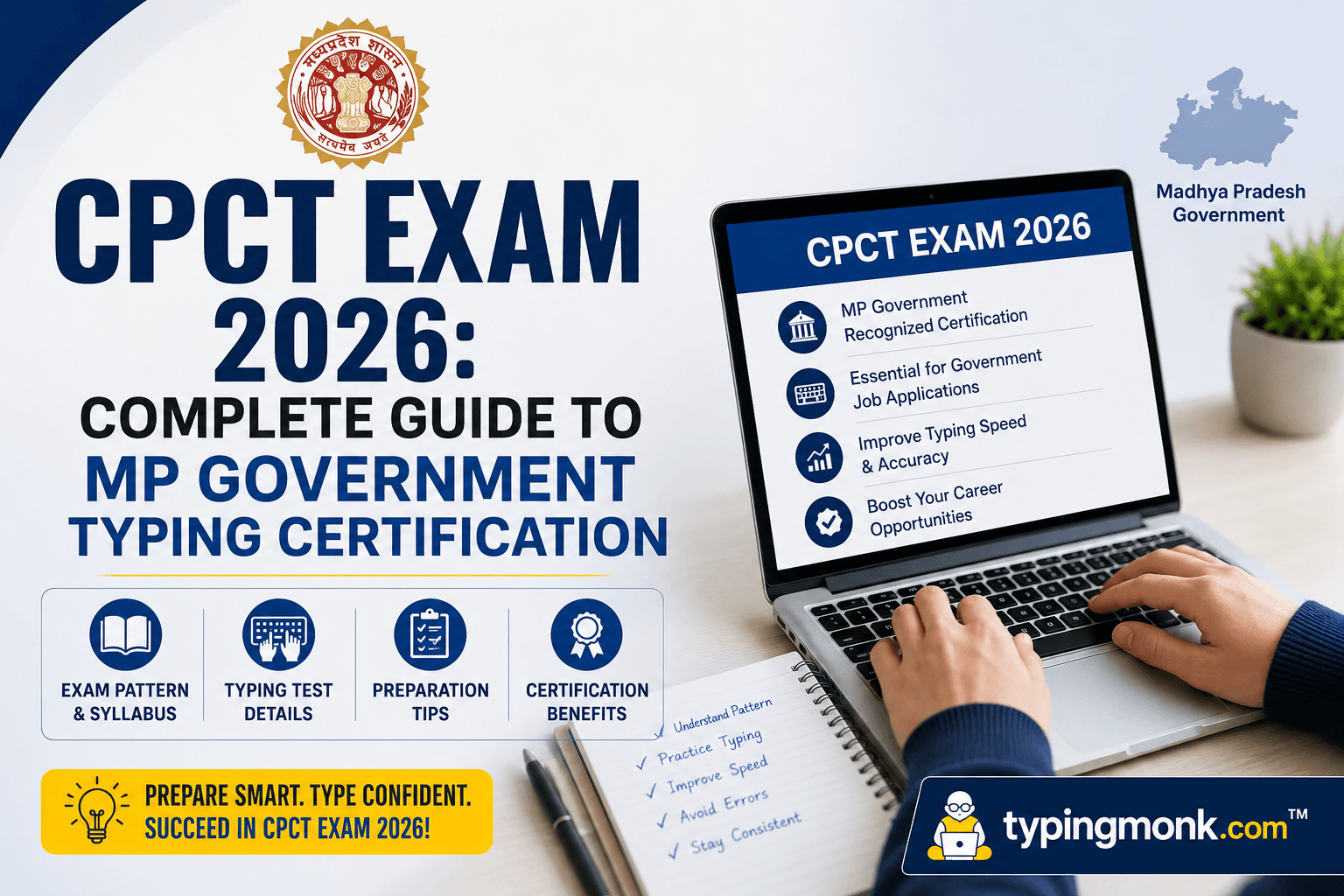
The Computer Proficiency Certification Test, commonly known as CPCT, is a standardized examination conducted by MAP-IT (Madhya Pradesh Agency for Promotion of Information Technology) on behalf of the Madhya Pradesh state government. Its purpose is to certify that candidates applying for state government positions have the minimum required computer knowledge and typing proficiency.
Before CPCT was introduced, different recruiting departments tested computer skills in ad-hoc ways, leading to inconsistent standards across the state administration. CPCT replaced that fragmented approach with a single, statewide certification that is now mandatory for a wide range of Group 2 and Group 3 government positions in Madhya Pradesh.
If you are preparing for MP government jobs — whether as a Patwari, Panchayat Sachiv, Data Entry Operator, LDC, or any other clerical or administrative post — CPCT is not optional. Understanding exactly what it tests, how it is scored, and how long your scorecard remains valid is essential before you begin preparing.
Eligibility Criteria
CPCT has simple eligibility requirements. You must have passed Higher Secondary (10+2 or Class 12) from a recognized board, or hold a Polytechnic Diploma obtained after Class 10. The minimum age is 18 years on the date of registration. There is no upper age limit for CPCT itself — age restrictions for specific jobs are set by the recruiting department, not by CPCT.
Importantly, CPCT does not require a formal computer science background. The objective section tests general computer awareness and MS Office skills that any 12th-pass candidate can learn with focused preparation.
Exam Pattern: Two Distinct Parts
CPCT consists of two separate parts, and a candidate must pass both to receive a valid scorecard. Passing only one part is not sufficient.
### Part 1: Objective Multiple Choice Questions
The MCQ section contains 75 questions worth 75 marks total. You have 75 minutes to complete it. There is no negative marking. The passing score is 50 percent, meaning you need at least 38 marks out of 75.
The syllabus for the MCQ section covers several broad areas:
Computer Systems and Hardware covers topics like the CPU, RAM, ROM, storage devices, input and output peripherals, and how computers process data. Basic Computer Operations covers the Windows operating system, file and folder management, keyboard shortcuts, and desktop management. General IT Skills covers internet concepts, browsers, email, social media basics, and cybersecurity awareness. MS Office covers MS Word, MS Excel, and MS PowerPoint — formatting, formulas, charts, presentations, and mail merge are commonly tested. Mathematical and Reasoning Aptitude covers number series, analogies, simple calculations, and logical reasoning. Reading Comprehension includes short English or Hindi passages with questions about content and vocabulary. General Awareness includes current events, geography, history, and India-specific knowledge.
Questions on MS Office shortcuts are predictable high-value items — Ctrl+C, Ctrl+V, Ctrl+Z, Ctrl+B, Ctrl+S, F7 for spell check, Alt+F4 to close, and similar shortcuts appear frequently and are easy marks.
### Part 2: Typing Test
The typing section has two separate tests, one for English and one for Hindi. You must meet the minimum speed in both.
English Typing Test: 15 minutes duration, minimum required speed of 30 Net Words Per Minute (NWPM).
Hindi Typing Test: 15 minutes duration, minimum required speed of 20 NWPM.
For Hindi, you can choose between the Remington Gail keyboard layout and the Inscript Unicode layout. Your choice must be made before the test and cannot be changed during it.
A critical difference from SSC exams: CPCT allows backspace. You can correct errors during the test, and your net speed reflects accuracy after corrections. This makes CPCT more forgiving than the SSC typing test, where backspace is completely disabled.
How NWPM Is Calculated in CPCT
Net WPM in CPCT is calculated as: (Total correct words typed) ÷ (minutes elapsed). Corrections via backspace are accounted for in the final count — if you type a word wrong and fix it, it counts as correct. If you leave errors uncorrected, those words are not counted in your net score.
This means the most effective strategy is to type at a controlled speed with high accuracy, correcting errors immediately rather than moving past them. Rushing and leaving errors unfixed will hurt your score more than typing slightly slower with precision.
CPCT Scorecard: Validity and Contents
Upon passing both the MCQ and typing sections, you receive an official CPCT scorecard. This scorecard contains your MCQ score out of 75, your English typing speed in NWPM, and your Hindi typing speed in NWPM.
The scorecard is valid for seven years from the date of the examination. A scorecard earned in May 2026 remains valid until May 2033. This generous validity period means you only need to pass CPCT once for most of your early career applications.
Different job recruitments specify minimum thresholds. Some may accept the base 30 NWPM English and 20 NWPM Hindi, while others set higher bars. Scoring well above the minimum (targeting 40+ NWPM English and 28+ NWPM Hindi) ensures your scorecard qualifies for all available positions.
Exam Fee and Frequency
The CPCT registration and examination fee is Rs. 660 for all candidates. There is no fee concession for reserved categories. The exam is conducted four to five times per year, so candidates who do not pass on their first attempt can re-appear relatively quickly. Your best scorecard from any valid attempt is considered for job applications.
Jobs That Require a CPCT Score
The following MP government positions mandate a valid CPCT scorecard as part of the selection process:
Data Entry Operator positions across all state departments. Typist posts in the Secretariat and district offices. Lower Division Clerk (LDC) in various departments. Upper Division Clerk (UDC) in district administration. Office Assistant roles. Patwari posts under the Revenue Department (since the 2022 recruitment batch, CPCT is mandatory). Panchayat Sachiv (Village Administrative Secretary) posts. Sahayak Grade 3 (Assistant Grade 3) positions. MP ESB (Employment and Subordinate Service Board) Group 2 and Group 3 posts. Madhya Pradesh Electricity Board (MPEB) clerical positions.
With MP government actively digitizing its administration, the number of positions requiring CPCT continues to grow. Even for posts where CPCT is currently preferred but not mandatory, holding a valid scorecard strengthens your application significantly.
MCQ Section: Smart Preparation Strategy
Given that the MCQ section has no negative marking, attempting all 75 questions is always the right approach. The 50 percent passing threshold (38 out of 75) is achievable with focused preparation over four to six weeks.
Prioritize MS Office in your study plan. At least 15 to 20 questions typically come from Word, Excel, and PowerPoint combined. Study the most commonly tested functions: creating and formatting documents in Word, building formulas in Excel (SUM, AVERAGE, IF, VLOOKUP), and designing slide shows in PowerPoint. Practice the shortcut keys for all three applications.
For Computer Systems, focus on definitions and functions rather than deep technical knowledge. Know what RAM and ROM do, what different storage capacities mean (KB, MB, GB, TB), what input devices versus output devices are, and basic CPU architecture.
Internet and email topics are straightforward. Know what URL, HTTP, HTTPS, IP address, and browser mean. Understand basic email etiquette and how to use attachments.
Typing Preparation: English
For the English typing test, your target should be 38 to 42 NWPM in practice — a buffer above the 30 NWPM minimum. Use platforms like TypingClub, Monkeytype, or 10FastFingers for daily practice.
Because CPCT allows backspace, develop a habit of correcting errors as you go rather than ignoring them and moving forward. A corrected word counts fully; an uncorrected error counts as zero.
Government passages in CPCT use formal Hindi and English prose. Practicing with news articles, government notifications, and administrative text is more useful than practicing with casual sentences.
Typing Preparation: Hindi
Hindi typing preparation depends on your chosen layout. Remington Gail is the traditional typewriter-based layout used in most typing institutes. If you have already practiced on a typewriter or learned typing through a coaching institute, you likely know this layout. Remington Gail is also the layout used in SSC and other competitive exams, so learning it serves multiple purposes.
Inscript is a phonetically intuitive layout where Hindi letters are placed near their phonetic English equivalents. If you are learning typing from scratch and have no prior typewriter experience, some coaches recommend Inscript for its logical structure. However, Remington Gail dominates the government exam ecosystem.
Target 26 to 30 NWPM in Hindi practice for a comfortable safety margin above the 20 NWPM requirement.
Common Reasons Candidates Fail CPCT
The most common failure in the MCQ section is underestimating the MS Office component and focusing only on theoretical computer knowledge. Many candidates score poorly on practical application questions because they have read about features but never actually used the software.
In the typing section, over-reliance on speed without correcting errors is the main pitfall. Since CPCT allows correction, candidates who type fast but leave errors uncorrected end up with lower net WPM than slower typists who fix their mistakes.
For Hindi, many candidates practice on the wrong keyboard layout and then struggle to switch during the exam. Confirm your chosen layout well in advance and practice exclusively on that layout for at least four weeks before the exam.
Taking the Exam Multiple Times
If your first CPCT attempt does not produce the score you need, re-appearing is straightforward. Pay the Rs. 660 fee again, register for the next scheduled exam date, and attempt to improve your scores. For job applications, your highest valid scorecard is used.
Many successful MP government employees earned their first CPCT scorecard on a second or third attempt after adjusting their preparation strategy. The key is to diagnose specifically what went wrong — MCQ subject knowledge, typing speed, accuracy, or layout familiarity — and address that weakness directly before the next attempt.
Final Advice
CPCT is a genuinely achievable examination. The typing requirements (30 NWPM English, 20 NWPM Hindi) are not demanding by professional standards — a few weeks of consistent practice is sufficient for most candidates. The MCQ section rewards systematic preparation over the right topics rather than encyclopedic computer knowledge.
Start your preparation at least three months before your target exam date. Divide your time roughly equally between MCQ study and typing practice in the first month, then shift to 70 percent typing and 30 percent MCQ revision in the second month, and spend the final month taking full mock tests under exam conditions. Approach CPCT as a structured exam rather than a casual online typing test, and your chances of clearing it comfortably are excellent.
Put it into practice
Take a free typing test and see your WPM right now.
Comments
Sign in to leave a comment.