Why Hindi Typing Matters in Government Exams
India has a massive government recruitment ecosystem, and for millions of aspirants from Hindi-speaking states, Hindi typing is not just a bonus skill — it is a mandatory qualification. From the SSC CHSL to RRB NTPC, from MP CPCT to Rajasthan High Court, nearly every major central and state recruitment that involves clerical work requires candidates to demonstrate Hindi typing proficiency.
Yet Hindi typing remains one of the most misunderstood aspects of exam preparation. The existence of multiple keyboard layouts, multiple fonts, and conflicting advice from different coaching institutes creates unnecessary confusion. This guide cuts through the noise and gives you a clear, practical framework for understanding and mastering Hindi typing for government examinations.
Two Systems, Two Philosophies
Hindi typing on computers is done through two fundamentally different systems. Understanding this difference is the first step.
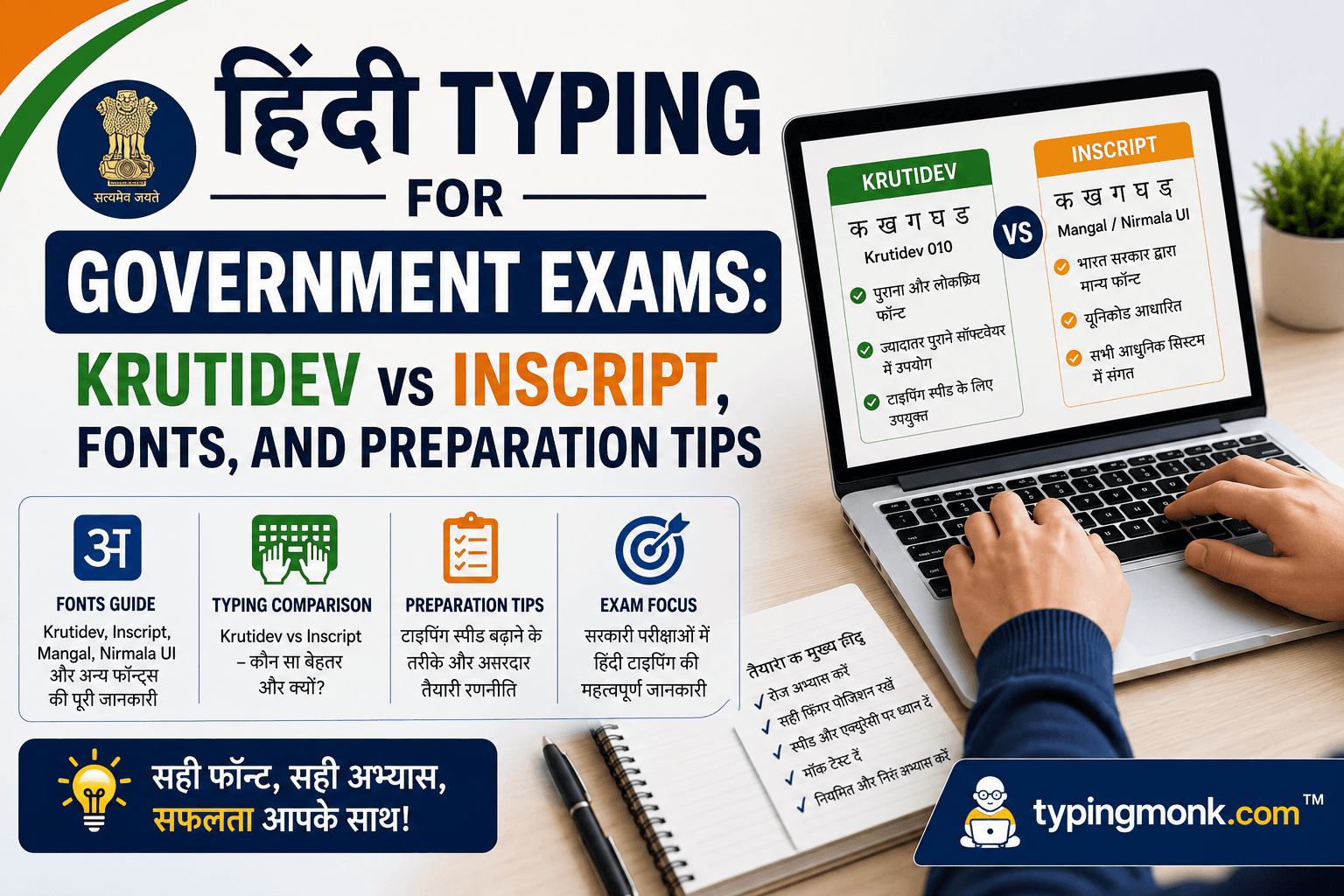
The first system is Remington Gail with Krutidev font. The second is Inscript keyboard with Mangal Unicode font.
These are not interchangeable. They represent different mappings of Hindi letters to keyboard keys, different font rendering technologies, and different historical origins. Mixing them up during an exam is one of the most costly mistakes an aspirant can make.
Krutidev Font and the Remington Gail Layout
Krutidev (also spelled Kruti Dev) is a non-Unicode Hindi font that was created to simulate the layout of traditional typewriters on computers. Before Unicode became standard, most government offices typed Hindi using Krutidev fonts because the typewriter-trained workforce knew Remington key mappings.
The Remington Gail keyboard layout maps Hindi letters to keyboard positions based on how they appeared on Hindi typewriters manufactured by the Remington company. The key positions are not phonetic — a Hindi letter's keyboard position in Remington has no relationship to its phonetic similarity to any English letter. Instead, it is a historical arrangement optimized for typewriter mechanics and finger reach on a manual typewriter.
Because India's government typing tradition grew directly from typewriter culture, Remington Gail became the dominant standard in government offices. Most typing institutes teaching Hindi government exam preparation use Remington Gail. If you learned typing at a Kailash or similar typing institute in any Hindi-belt state, you learned Remington Gail.
For exams like SSC CHSL (Krutidev 010 option), RRB NTPC, and most state government exams, Remington Gail is the expected layout. When you select "Krutidev" in the exam interface, the system expects Remington Gail key mappings.
Mangal Font and the Inscript Layout
Mangal is a Unicode font. Unicode means each Hindi character has a universal digital code that renders correctly across all modern operating systems, browsers, and applications. When you type in Mangal/Inscript, the resulting text is truly portable — it can be displayed on any device without needing the Krutidev font to be installed.
The Inscript (Indian Script) keyboard layout was designed by the Government of India's Department of Electronics to standardize Indian language input. Inscript is phonetically organized: the Hindi letter that sounds like the English letter on a key is placed in a phonetically corresponding position. For example, क (ka) is on the same key as k. This phonetic logic makes Inscript intuitive for people who are learning Hindi typing from scratch and have English keyboard experience.
Government documents produced after 2010 increasingly use Unicode Mangal because it is future-proof. The National Language Technology Commission recommends Unicode for all official government communication. Newer exam platforms and modern government offices are shifting toward Inscript/Mangal.
For exams like CPCT (Madhya Pradesh), some versions of SSC CHSL (where both options are offered), and newer state board exams, Mangal/Inscript is available as an alternative.
Which Layout Should You Learn?
This is the question every aspirant asks, and the honest answer depends on your situation.
If you are starting from zero and planning to appear in multiple government exams over the next several years, Inscript has real advantages: it is phonetically learnable in a shorter time, it produces Unicode output that works in modern applications, and it is gaining adoption in newer government software.
If you are already partially trained in Remington Gail, or if you are primarily targeting SSC or RRB exams in the near term, continue with Remington Gail. Switching layouts mid-preparation is extremely disruptive — you will feel slower and less accurate for weeks during the transition.
If you are targeting CPCT specifically, both layouts are available, and choosing Inscript for CPCT while keeping Remington Gail for SSC is possible but requires maintaining two separate muscle memories, which most people find difficult.
The practical advice for most aspirants: choose one layout, commit to it fully, and become excellent at it. Do not attempt to maintain both simultaneously.
The Hindi Keyboard in Detail: Remington Gail Layout
In the Remington Gail layout, the home row keys produce the following Hindi letters (reading approximately left to right): फ (pha), र (ra), द (da), ल (la), ड (ṭa with dot below) on the left, and ह (ha), ् (half mark/halant), न (na), म (ma), अ (a) on the right. The top row and bottom row contain vowels, consonants, and matras (vowel diacritics) distributed according to the original Remington typewriter key arrangement.
The matras — the small marks that modify consonants to indicate vowel sounds — are spread across the keyboard in positions that require specific key combinations. For example, the aa matra (ा) might be on one key while the i matra (ि) is on another, and these are not where a beginner might intuitively expect them.
Learning Remington Gail requires memorization through repetition. There is no logical shortcut. Most coaches recommend spending the first week on home row only, then adding rows progressively, exactly as touch typing is learned in English.
Common Error Patterns in Hindi Typing Exams
Half-mistakes (which deduct 0.5 words) in Hindi typing often come from matras. The most frequently mistyped elements are:
The aa matra (ा) and the long aa matras confused with each other. The i matra (ि) and ii matra (ी) which look similar but use different keys. Missing the chandrabindu or anusvaara (nasalization marks) that appear in words like अंग (anga) and आँगन (aangan). Incorrect spacing before and after punctuation marks in Devanagari text. The halant (्) which creates conjunct consonants — misplacing it creates completely different words.
Government passages in Hindi use formal administrative vocabulary. Words like कार्यालय (office), सूचना (notice), विभाग (department), अधिकारी (officer), and प्रस्ताव (proposal) appear frequently. Building familiarity with this vocabulary reduces the cognitive load during the test.
Practice Resources for Hindi Typing
EasyHindiTyping.com offers layout-specific practice for both Remington Gail and Inscript. IndiaTyping.com has a large bank of government-style Hindi passages with error tracking. TypeForExam.com provides SSC, CPCT, and RRB-specific Hindi practice modes. MultiTyping.in covers Hindi with Kruti Dev support. Hindi-Typing.com provides font-specific lessons.
For the best results, combine lesson-based practice (which teaches correct finger placement progressively) with passage-based practice (which builds stamina and accuracy on real exam content).
Daily Practice Structure
For a complete beginner, a 12-week plan is realistic. Spend the first three weeks on the home row only, practicing at a slow speed until all home row characters are automatic. In weeks four through six, add the top row characters and their matras. In weeks seven through nine, introduce the bottom row and numbers. In weeks ten through twelve, practice full passages at exam speed with no-backspace mode enabled.
For a candidate who already has basic Hindi typing but needs to improve speed: practice 30 minutes daily, 6 days per week. Focus on the specific characters where your speed drops — typically matras and conjuncts. Use timed practice at 5 WPM above your current speed, then settle back to your comfortable speed. Interval training of this type builds speed faster than constant-pace practice.
Meeting the Speed Requirements
The minimum Hindi typing speed for major exams: SSC CHSL requires 30 WPM. RRB NTPC requires 25 WPM. CPCT requires 20 NWPM. State PSC exams typically require 25 to 30 WPM depending on the state and post.
In practice, target speeds 5 to 8 WPM above the requirement. Exam-day performance is typically lower than practice performance due to unfamiliar passage content and pressure. A candidate who consistently achieves 35 WPM in practice has enough margin to clear a 30 WPM requirement even on a difficult day.
The Future of Hindi Typing in Government Jobs
As Indian government offices modernize, the shift toward Unicode (Mangal/Inscript) is accelerating. Documents prepared in Krutidev cannot be easily shared across systems without the font installed. The Pradhan Mantri Rojgar Yojana portals, Central Government HR management systems, and state government e-office platforms all use Unicode. This trend suggests that over the next decade, Inscript may become the dominant standard in government Hindi typing.
For current exam aspirants, the practical implication is: if you are starting fresh, Inscript is a future-proof investment. If you are already proficient in Remington Gail, your skill is sufficient for current exams and will remain relevant for several years.
Either way, Hindi typing is a durable and valuable skill for anyone pursuing a government career in India's Hindi-speaking belt. Invest in it seriously, practice consistently, and it will serve you not just through the exam but throughout your government service.
Put it into practice
Take a free typing test and see your WPM right now.
Comments
Sign in to leave a comment.