What muscle memory actually is
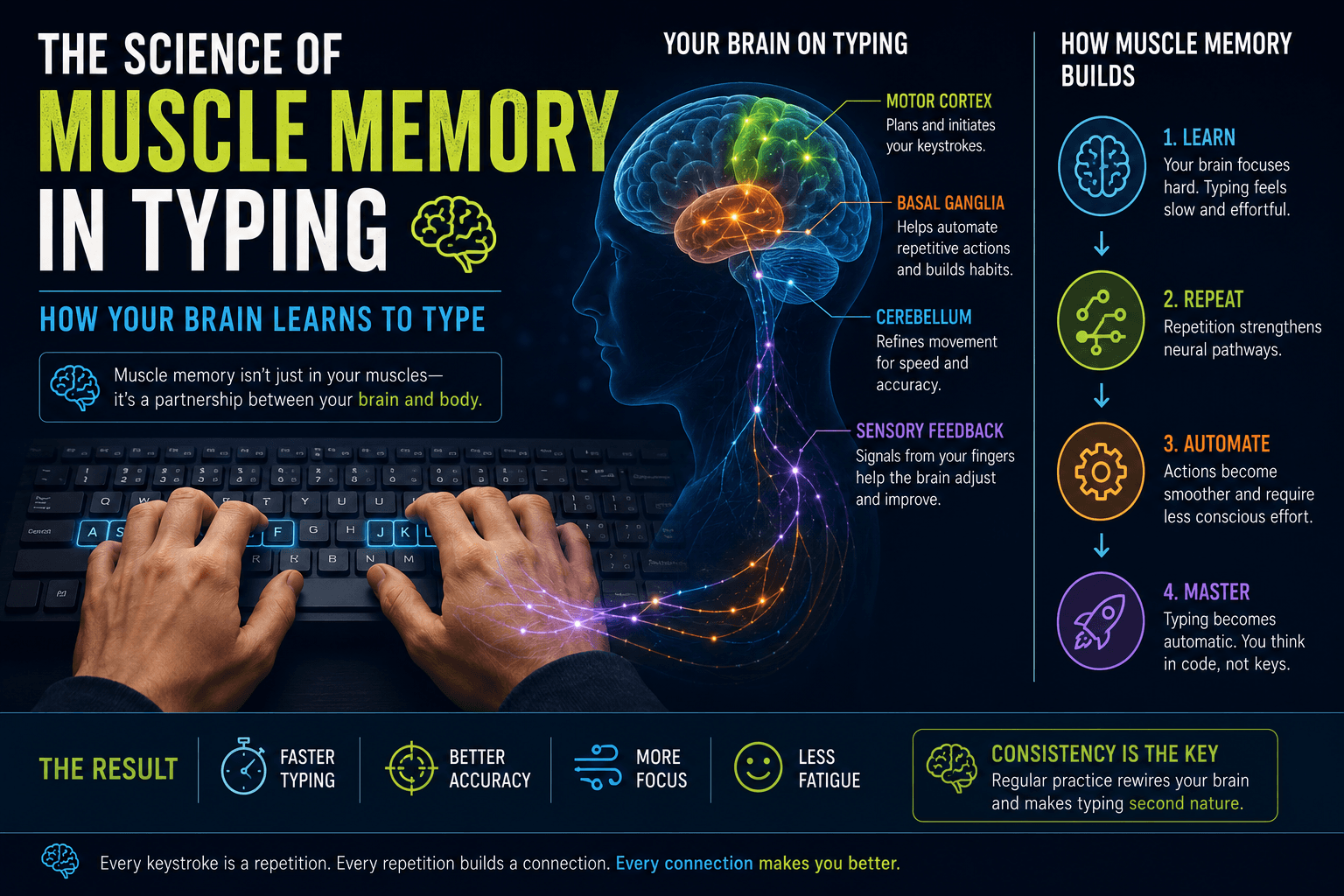
The term 'muscle memory' is a popular shorthand for a process that actually occurs primarily in the brain, not the muscles. Muscles themselves do not store memories — they execute commands. The memory is in the motor cortex, cerebellum, and basal ganglia: brain regions that store and execute well-practiced movement sequences. When you type a frequently-used word, the neural program for that word's keystrokes can be executed with minimal conscious attention, freeing your prefrontal cortex for higher-level tasks like choosing words and forming sentences.
Motor learning researchers distinguish between declarative memory (knowing that ASDF are the left home row keys) and procedural memory (the automatic execution of the correct finger movements when typing 'said' or 'fast'). Beginners rely heavily on declarative memory — they consciously think about each key. Experienced typists rely on procedural memory — execution is automatic. The transition from declarative to procedural is the core process of becoming a fast typist.
The neurological stages of skill acquisition
Motor learning researchers Paul Fitts and Michael Posner described three stages of motor skill acquisition that directly apply to typing. Stage 1 (Cognitive): The learner consciously thinks about each action. Typing a single word requires deliberate attention to each letter and key location. Progress is uneven; errors are frequent. This is the phase most beginners are in when first learning touch typing. Stage 2 (Associative): The learner has begun to chain movements together. Some common words or sequences are becoming automatic. Errors are less frequent; performance starts to feel more consistent. Most intermediate typists operate here.
Stage 3 (Autonomous / Automatic): Movement sequences are executed procedurally with minimal conscious attention. The typist can hold a conversation or think about content while typing familiar material at high speed. Expert typists, particularly those above 80–90 WPM, operate here for most common vocabulary. Novel words or unusual sequences require a brief return to Stage 2 processing, which is why typing speed drops slightly on Very Hard difficulty text with uncommon words.
Chunking: how experts type faster than letter-by-letter
A critical mechanism in expert typing is chunking — the grouping of individual keystrokes into larger movement units executed as a single program. Beginner typists process one letter at a time. Intermediate typists begin chunking common digraphs (th, er, in, re) into single movement programs. Expert typists chunk entire common words (the, and, that, this, with) or even phrase-level sequences into single ballistic movement programs executed faster than any letter-by-letter process could achieve.
This is why expert typists type certain common words at rates that seem to exceed their WPM average — those words are stored as single chunks. It is also why expert typists slow down significantly on unusual proper nouns or technical vocabulary: those cannot be retrieved as pre-stored chunks and must be assembled letter-by-letter. For practice purposes, this means deliberately practicing common words at high volume (through typing tests on standard text) builds the chunk library that enables expert speed.
Sleep and consolidation: why rest matters
Motor learning research has consistently found that newly acquired motor skills are consolidated during sleep — particularly during slow-wave sleep and REM sleep phases. The practical implication is striking: subjects who practiced a finger-tapping sequence showed measurable improvement after a night of sleep even without additional practice, while subjects who were kept awake for the same period showed less improvement. Practicing typing before sleep may produce better overnight consolidation than an equivalent session earlier in the day.
This research also explains why consistent daily practice produces better learning curves than equivalent hours concentrated in fewer sessions. Daily practice ensures daily sleep cycles to consolidate each session's learning. A practitioner who types for 20 minutes each day gets 7 consolidation cycles per week; one who practices for 140 minutes in a single weekly session gets only 1. The distributed schedule is substantially more efficient for building motor programs.
Deliberate practice vs naive practice
Not all practice is equal. In his influential work on expertise, psychologist Anders Ericsson distinguished between naive practice (repeating a task without focused improvement intent) and deliberate practice (focused effort on the specific aspects of the skill that are currently the weakest link, with immediate feedback). For typing, naive practice is taking the same test on Easy difficulty every day and watching your numbers plateau. Deliberate practice is identifying your error characters, targeting them specifically, working at the edge of your current capability, and tracking whether the error rate on those specific characters decreases.
For deliberate typing practice: vary difficulty regularly (spend time at Hard and Very Hard, not always on Easy), actively monitor your error characters rather than just your WPM, and occasionally drop to very slow, very accurate practice to reinforce correct movements for your problem keys. The variety and targeted focus of deliberate practice produce faster improvement than high-volume naive repetition.
Practical application: how to train for automaticity
To move from Stage 2 (Associative) to Stage 3 (Autonomous) typing, you need to practice at slightly above your comfortable speed while maintaining acceptable accuracy. This threshold — the edge of current capability — is where the nervous system is most efficiently building new programs. Below this threshold (comfortable easy practice) produces maintenance but little new learning. Above this threshold (so fast that accuracy collapses) produces mostly error reinforcement.
A practical method: find your Medium-difficulty 3-minute test WPM. Set a target 5 WPM above it. Focus each practice session on sustaining that target speed while keeping accuracy above 93%. When you can hold 93%+ accuracy at the target speed consistently across three separate tests, raise the target by another 5 WPM. This progressive overload method mirrors the approach used in motor skill training across sports and music and produces reliable, measurable progress.
Put it into practice
Take a free typing test and see your WPM right now.
Comments
Sign in to leave a comment.