Overview of the RRB NTPC Typing Skill Test
The Railway Recruitment Board (RRB) conducts the Non-Technical Popular Categories (NTPC) examination to fill thousands of positions across Indian Railways each year. Among the various NTPC posts, a specific subset requires candidates to clear a typing skill test before final appointment. Understanding which posts require typing, what speed is expected, and how the test is evaluated is critical for every NTPC aspirant.
The typing test is conducted after the Computer-Based Test (CBT-1) and CBT-2 stages. It is a qualifying test — it does not contribute marks to your merit list. However, failing the typing test means disqualification regardless of how well you performed in the written stages. Thousands of candidates who clear both CBT stages still lose their railway jobs because they did not prepare for this final hurdle.
Posts That Require Typing Skill Test in NTPC
Not all NTPC posts require a typing test. Only the following categories mandate it:
Junior Accounts Assistant cum Typist (JAA-T) and Senior Accounts Assistant cum Typist (SAA-T) require typing in both English and Hindi. Junior Time Keeper posts also require typing skills for clerical documentation. Senior Clerk cum Typist and Junior Clerk cum Typist posts in various railway departments require typing. Accounts Clerk cum Typist posts in Accounts and Finance departments need typing proficiency.
Posts like Junior Stenographer and Senior Stenographer have a separate stenography test with higher speed requirements. Group D positions in Railways do not require any typing test at all.
Check the official notification for the specific recruitment year you are applying to, as post-specific requirements can change between cycles.
Speed Requirements
The typing speed requirements for RRB NTPC are:
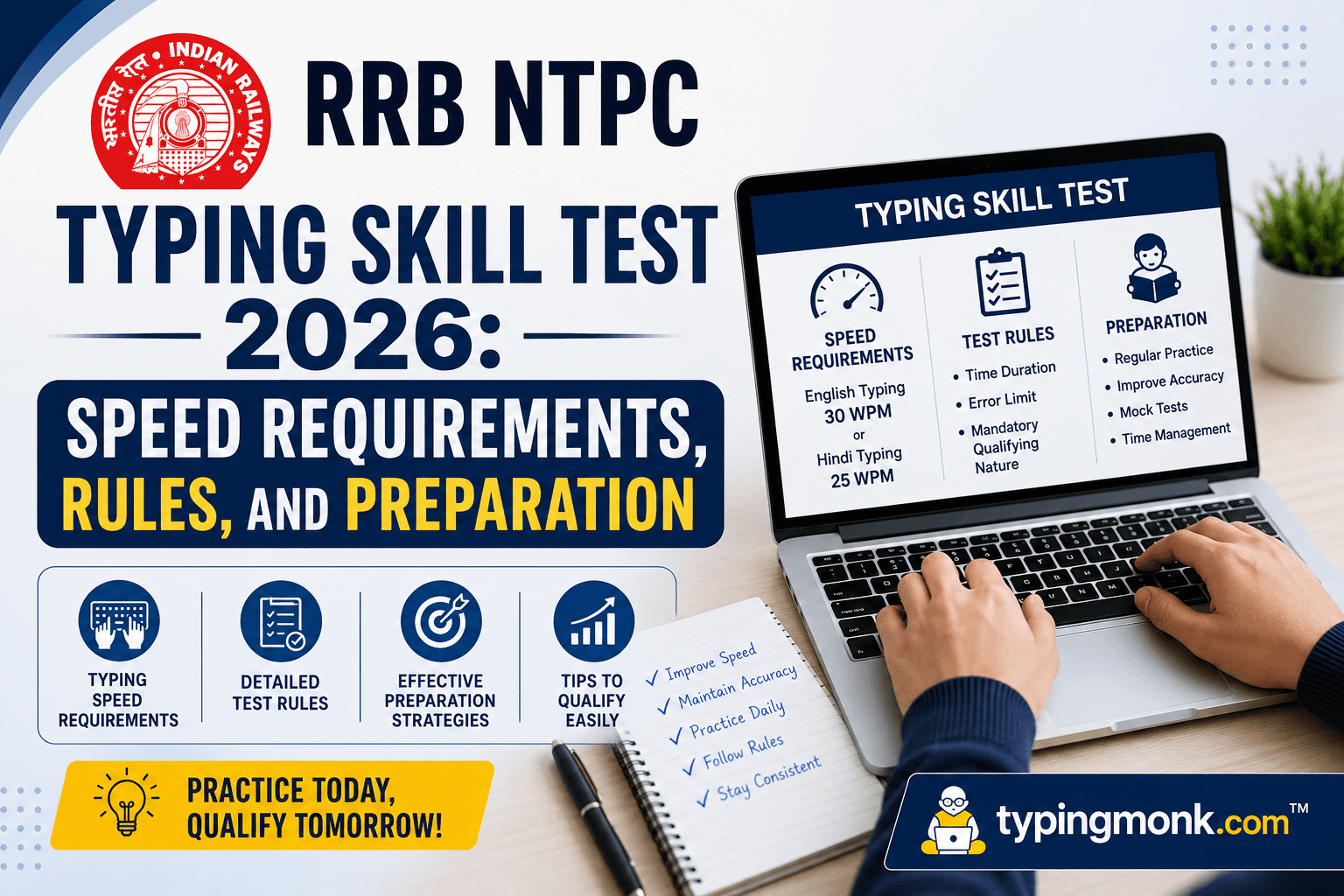
English typing: 30 Words Per Minute (type approximately 300 words in 10 minutes) Hindi typing: 25 Words Per Minute (type approximately 250 words in 10 minutes)
These speeds are slightly lower than SSC requirements (which are 35 WPM for English and 30 WPM for Hindi), making RRB NTPC relatively more accessible for candidates who are still building their typing skills.
The test duration is 10 minutes for both languages. You choose one language for the test; you cannot switch languages once the test begins.
The No-Backspace Rule
Like the SSC typing test, the RRB NTPC typing skill test disables the backspace key completely. Once you type a character, it remains permanently. Arrow keys for cursor repositioning are also disabled. Spell check, AutoCorrect, and editing tools are turned off.
This rule changes preparation fundamentally. Practicing on standard word processors or casual typing websites does not adequately prepare you for exam conditions. You must specifically practice on platforms that simulate the no-backspace environment.
This rule also means that attempting to mentally fix errors while typing costs you more than the errors themselves. The time lost hovering over an error without being able to fix it, then resuming typing, breaks your rhythm and can cost you 5 to 10 WPM overall. The only correct approach is to keep typing forward regardless of visible errors.
Error Deduction System
RRB uses a specific error calculation method that differs slightly from SSC's approach.
The first 5 percent of total words typed are treated as a grace allowance — errors within this count are not penalized. Beyond this 5 percent threshold, the standard error deductions apply: a Full Mistake (wrong word, omitted word, extra word) deducts one word from your gross count; a Half Mistake (spacing error, capitalization error, punctuation error) deducts half a word.
Example calculation: You type 320 words in 10 minutes (gross 32 WPM). The 5 percent grace covers the first 16 words of errors. You have 8 full mistakes and 10 half mistakes. The grace absorbs the first 16 words of error equivalents (8 + 10×0.5 = 13 deduction words, but your grace is 16 — so you are fully covered). Net WPM = 32. You pass (requirement: 30 WPM).
Revised example: You type 320 words but have 18 full mistakes and 12 half mistakes. Total deduction: 18 + 6 = 24 words. Grace covers 16 words. Effective deduction beyond grace: 8 words. Net words: 320 − 8 = 312. Net WPM: 31.2. You still pass — barely.
These calculations show that the grace allowance is genuinely helpful, but relying on it as a safety net encourages sloppy typing. The most reliable approach is to keep errors minimal regardless of grace.
Hindi Typing Fonts and Keyboards
For Hindi typing in RRB NTPC, the standard font is Kruti Dev (also written as KrutiDev) using the Remington keyboard layout. Some newer test centers offer Mangal Unicode with Inscript layout as an alternative.
Kruti Dev/Remington is the traditional choice and what most typing institutes teach. If you have been preparing for Hindi typing through an institute or with government exam coaching, you are almost certainly using Kruti Dev. The Inscript layout is more phonetically logical but requires learning a completely new key mapping.
Do not attempt to switch Hindi layouts close to the exam. Stick with whichever layout you have been practicing with, and confirm the available options at your specific test center through the official RRB notification.
Content and Passage Style
RRB typing test passages use railway-specific and general administrative language. Common themes include operational instructions, timetable notices, safety protocols, administrative circulars, and service conditions. Passages contain railway-specific vocabulary: locomotive, buffer, gauge, signalling, track maintenance, yard, marshalling, divisional headquarters, general manager, and so on.
Practicing general English prose is useful as a base, but adding railway domain content to your practice significantly improves your comfort with passage content. IndiaTyping.com and TypeForExam.com have NTPC-specific passage banks for this purpose.
Recommended Practice Schedule
A 10-week preparation timeline works effectively for most aspirants preparing for NTPC typing alongside other exam stages.
Weeks 1 to 2: Focus on touch typing technique. Ensure all 10 fingers are used correctly. Speed does not matter yet — accuracy and finger placement are the goals. Target 20 WPM at 95 percent accuracy.
Weeks 3 and 4: Push speed to 25 to 28 WPM while maintaining accuracy. Introduce no-backspace practice platforms. Start with 5-minute sessions, extending to 10 minutes as comfort builds.
Weeks 5 and 6: Practice at or slightly above target speed (30+ WPM for English, 25+ for Hindi). Focus specifically on punctuation, spacing, and capitalization — the most common sources of half-mistakes.
Weeks 7 and 8: Full 10-minute mock tests daily. Review error reports to identify which types of mistakes are most frequent. Adjust practice content to address specific weaknesses.
Weeks 9 and 10: Consolidation and confidence building. Take two to three full mock tests per day. Maintain a practice log to track speed and accuracy trends.
Platforms to Practice on for RRB NTPC
Several platforms offer exam-specific typing practice suited for RRB NTPC preparation:
TypeForExam.com provides dedicated NTPC passage banks with no-backspace mode. IndiaTyping.com covers both English and Hindi with error reporting suitable for government exam preparation. MultiTyping.in includes Railway-specific typing modes with Kruti Dev support. ARTypingPlatform.com covers all major Indian government exams with realistic exam interfaces. EasyHindiTyping.com is particularly useful for Hindi practice and Remington Gail layout training.
The Role of Typing in Railway Careers
Understanding why Railways require typing helps contextualize the preparation. JAA-T and SAA-T roles in railway accounts departments involve preparing financial statements, correspondence, and internal reports. Junior and Senior Clerk cum Typist roles handle daily administrative correspondence, notices, and documentation. Even a small error in financial or safety-related documentation can have significant consequences in a railway environment — hence the emphasis on both speed and accuracy.
Candidates who excel in typing find that this skill pays dividends throughout their railway career, not just at the selection stage. Faster, more accurate documentation reduces errors in official railway records and builds a reputation for reliability.
What to Do If You Do Not Pass
If you do not clear the typing skill test, you may re-appear in the next RRB NTPC cycle. Your CBT-1 and CBT-2 scores are not carried forward between recruitment cycles — you must clear the full examination again.
This makes it all the more important to not let typing preparation slip during CBT preparation. Many candidates focus entirely on CBT-1 and CBT-2 (which are competitive and marks-based) and treat typing as an afterthought. Then they find themselves failing a qualifying test and having to restart the entire process.
Start typing practice early, run it in parallel with your CBT preparation from day one, and treat the 30 WPM English / 25 WPM Hindi requirement as the floor you need to consistently beat in practice before exam day arrives.
Key Differences Between RRB and SSC Typing Tests
A quick comparison helps aspirants who may be preparing for both exams simultaneously.
Speed: SSC CHSL requires 35 WPM English / 30 WPM Hindi; RRB NTPC requires 30 WPM English / 25 WPM Hindi. RRB is 5 WPM lower in both languages.
Error system: SSC categorizes all errors as full or half mistakes from the first word. RRB provides a 5 percent grace window before error deductions kick in. RRB is slightly more forgiving.
Both tests disable backspace and require qualifying scores. Both use government-style passages with formal language and precise punctuation.
If you are preparing for SSC as your primary target, you are automatically over-prepared for RRB NTPC typing. If NTPC is your primary target, prepare to 35 WPM in English anyway — the safety margin is worth having.
Put it into practice
Take a free typing test and see your WPM right now.
Comments
Sign in to leave a comment.