Why Job-Specific Typing Benchmarks Matter
Typing speed benchmarks vary enormously across professions, and knowing the right target for your specific career saves you significant preparation time. A data entry specialist who sets their training goal at 40 WPM is under-prepared. A government clerk who trains to 100 WPM is over-preparing for a test that requires 35 WPM.
This guide provides detailed, research-based typing speed and accuracy requirements for over fifteen distinct job categories, explains how each role uses typing differently, and gives you a realistic benchmark for where you need to be to compete effectively for positions in each field.
Understanding the Two Dimensions: Speed and Accuracy
Every typing requirement has two components: speed (measured in WPM or net WPM) and accuracy (measured as a percentage of correctly typed characters). Both matter, and the relative importance shifts by role.
Data entry roles weight accuracy extremely heavily because errors in entered data create cascading problems — incorrect records, processing failures, customer service issues. A data entry operator who types 65 WPM at 96% accuracy is more valuable than one who types 80 WPM at 88% accuracy.
Customer service typing weights speed more, because live chat response time directly affects customer satisfaction. A customer service agent who types 55 WPM at 96% accuracy handles more conversations efficiently than one who types 45 WPM at 99% accuracy.
Medical transcription demands both — 65+ WPM and 99%+ accuracy — because the consequences of errors in medical records are patient safety risks, not merely inconveniences.
Keep both dimensions in mind as you read the requirements for each role below.
Government Clerk and Administrative Positions (India)
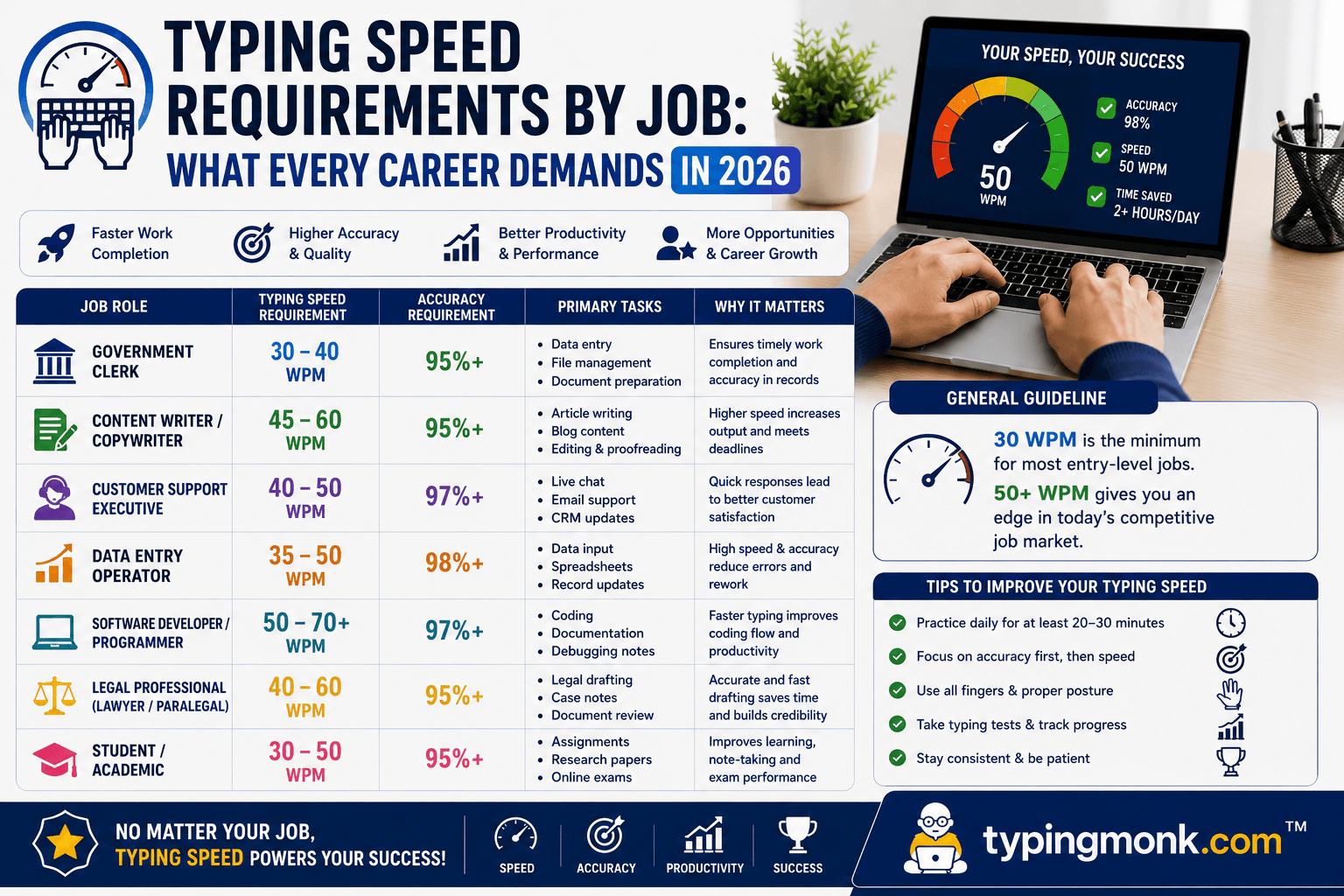
Indian government clerical positions set the minimum bar across the typing profession. Lower Division Clerk, Junior Secretariat Assistant, and similar posts require 30 to 35 WPM in English and 25 to 30 WPM in Hindi through qualifying skill tests.
These requirements may seem low, but the qualifying nature of the test (pass/fail, not merit-ranked) means meeting them at all is the threshold. The average working speed required for actual job duties is typically higher — government correspondence involves sustained typing of formal documents at 40 to 50 WPM over a full workday.
State government jobs vary: Rajasthan High Court requires 35 WPM English with very high accuracy (95%+), and accuracy is merit-ranked. UPSSSC positions require 30 WPM. CPCT (Madhya Pradesh) requires 30 NWPM English and 20 NWPM Hindi.
Receptionist and Front Desk Roles
Minimum requirement: 40 WPM at 95% accuracy. Preferred: 50 to 60 WPM at 97% accuracy.
Receptionists type a mix of tasks: scheduling entries, email correspondence, data entry into reservation or patient management systems, and live chat or message taking. The work is often interrupted, meaning the effective typing challenge is resuming at speed after frequent pauses — a skill that sustained practice at above-threshold speed builds naturally.
The 40 WPM minimum is widely cited in job descriptions, but candidates who can demonstrate 55 to 60 WPM are notably stronger applicants in competitive hiring. Accuracy matters more than raw speed because scheduling and data errors create visible and immediate operational problems.
Administrative Assistant and Executive Assistant
Minimum requirement: 50 WPM at 95% accuracy. Preferred: 60 to 70 WPM at 97% accuracy.
Executive assistants in corporate environments type large volumes of high-quality correspondence, formal documents, meeting minutes, and reports. The ability to take dictation — either from a recording or in real time — is a valued secondary skill. For real-time dictation transcription, speeds of 70 to 80 WPM with excellent accuracy are typically required.
Many executive assistant job postings do not explicitly state a WPM requirement but will test candidates with a typing assessment during the interview process. Coming in at 65+ WPM positions you well above the average applicant for these roles.
Data Entry Operator and Clerk
Minimum requirement: 45 to 50 WPM at 98% accuracy. Preferred: 65 to 80 WPM at 99% accuracy.
Data entry is the most accuracy-sensitive typing role. Operators typically enter structured data into databases, spreadsheets, or legacy systems from paper forms, scanned documents, or audio sources. The data types include alphanumeric codes, financial figures, address data, inventory records, and customer information.
Error rates in data entry translate directly into corrupted records. A 98% accuracy rate means 2 errors per 100 words — for a 1,000-word entry session, that is 20 errors that must be caught and corrected in quality control. Highly specialized data entry operations (financial transaction processing, medical coding) may require 99%+ accuracy.
The KPH (keystrokes per hour) metric is commonly used in data entry hiring: a typical minimum of 8,000 KPH (equivalent to about 27 WPM), with proficient operators reaching 12,000 to 15,000 KPH (40 to 50 WPM), and specialists achieving 20,000 to 27,000 KPH (65 to 90 WPM).
Customer Service Representative (Live Chat)
Minimum requirement: 40 WPM at 95% accuracy. Preferred: 55 to 65 WPM at 97% accuracy.
Live chat customer service has become one of the most typing-intensive roles in modern service operations. Agents simultaneously manage multiple chat conversations, read and interpret customer messages, access knowledge bases, and compose helpful, professional responses. The ability to type at speed while thinking and multitasking is a specific skill requirement beyond raw WPM.
Many customer service operations set their minimum at 40 WPM for initial hiring but evaluate agents with below 55 WPM for performance improvement plans because response time directly affects customer satisfaction scores. Typing speed tests are standard in customer service hiring processes across industries.
Journalist and Content Writer
Minimum for effective work: 55 to 60 WPM. Typical professional speed: 65 to 80 WPM.
Journalists writing under deadline pressure need speed to get stories filed efficiently. Feature writers and content creators benefit from higher speeds because they produce larger volumes of polished prose and ideas flow faster when the fingers can keep pace with thought.
Journalism does not typically have a formal minimum WPM requirement — it is more of an observed professional norm. However, working journalists who type below 50 WPM consistently report that their speed limits their output and creates stress under deadline conditions.
The relationship between typing speed and writing quality is interesting: research suggests that faster typists produce longer, more developed documents, not because they think faster, but because the lower friction between thought and text reduces interruptions to the writing flow.
Programmer and Software Developer
Minimum for effective work: 50 WPM. Typical professional speed: 60 to 80 WPM.
Programming typing is fundamentally different from prose typing. Code involves frequent use of symbols (braces, brackets, semicolons, underscores, carets), specific indentation, and longer variable names rather than natural English words. The thinking pauses between code segments are longer than in prose writing.
These differences mean a programmer typing 65 WPM is not necessarily 65% more productive than one typing 50 WPM — the cognitive work of problem-solving, not typing speed, is the bottleneck for most programming tasks. However, in IDEs, terminal work, command-line operations, and code review commenting, higher typing speed does improve workflow efficiency noticeably.
Highly efficient programmers often use keyboard shortcuts, snippet expansion, and editor macros to reduce total keystrokes, making effective productivity more than a function of raw WPM. Vim and Emacs power users in particular optimize for minimal keystrokes rather than maximum WPM on standard input.
Legal Professional (Lawyer, Paralegal, Legal Secretary)
Minimum for effective work: 55 to 60 WPM. Typical professional speed: 65 to 75 WPM.
Legal professionals produce extremely high volumes of formal, precise documents: briefs, contracts, motions, correspondence, and depositions. Legal documents cannot contain typographic errors — a misplaced clause or incorrect terminology can have significant legal consequences.
Legal secretaries and paralegals have among the highest average typing speeds of any professional category (approximately 60.6 WPM in aggregate data), reflecting the combination of high typing volume and professional pressure to produce accurate work quickly.
Court reporters (stenographers) work in a different category entirely, using specialized stenotype machines that produce 180 to 225 WPM. Standard keyboard typing is a separate skill; court reporting requires mastery of a completely different input technology.
Medical Transcriptionist
Minimum requirement: 65 WPM at 98% accuracy. Preferred: 80 to 90 WPM at 99% accuracy.
Medical transcriptionists listen to audio recordings of physician dictations — patient visits, operative reports, discharge summaries — and transcribe them into text records. The speed requirement is driven by the need to transcribe in real time or near-real time with a target of completing transcription within a turnaround time.
Medical terminology is complex and specialized: medications, procedures, anatomical terms, diagnostic codes, and pharmaceutical names must be spelled precisely because errors in medical records can affect patient care. Medical transcription is the most demanding combination of speed and accuracy in any standard typing profession.
The field has been affected by AI medical transcription tools, but human transcriptionists remain in demand for complex recordings, specialty documentation, and quality review of AI-generated transcripts.
Customer Support (Email and Ticketing)
Minimum requirement: 45 WPM. Preferred: 55 to 60 WPM.
Email and ticketing support differs from live chat in that responses are asynchronous — there is no live customer waiting in real time. However, support agents typically handle large volumes of tickets with response time SLA (Service Level Agreement) targets. Faster typing with high accuracy allows agents to maintain quality across a higher ticket volume, directly affecting performance metrics.
Accountant and Financial Analyst
Minimum for effective work: 45 WPM. Typical professional speed: 55 to 65 WPM.
Accounting professionals type a mix of numerical data entry (financial figures into spreadsheets), formal report writing, email correspondence, and documentation. The numerical input component means that proficiency with the number row and numeric keypad is particularly valuable — many accountants who can type at 60+ WPM on prose are significantly slower when entering dense numerical data if they have not specifically practiced number typing.
Teacher and Academic Professional
Minimum for effective work: 40 to 45 WPM. Typical professional speed: 50 to 60 WPM.
Teachers in 2026 type more than any previous generation in the profession — lesson plans, parent communications, assessment feedback, curriculum documents, administrative reports, and increasingly live classroom typing for interactive whiteboard tools. Teachers who type more efficiently invest fewer evening hours in administrative work.
How to Determine the Right Target for You
If you are preparing for a specific job application, the target is clear: research the minimum requirement for that role, add a 10 to 15 WPM buffer above the minimum, and practice to that buffer target.
If you are building general professional skills without a specific target role, the most broadly useful target is 60 WPM at 97% accuracy. This speed qualifies you for the majority of office, administrative, and professional roles without being in a specialized category. It is comfortably achievable for most adults within 3 to 6 months of consistent practice.
If you are specifically targeting Indian government exams, use the exact requirements for each exam as your floor and build a practice buffer of 5 to 8 WPM above the requirement to account for exam-day performance variation.
Typing is a skill that improves with deliberate practice at any age. The right target is specific, slightly above your current level, and connected to a concrete professional goal — that combination produces the fastest real-world improvement.
Put it into practice
Take a free typing test and see your WPM right now.
Comments
Sign in to leave a comment.