The Global Average Typing Speed
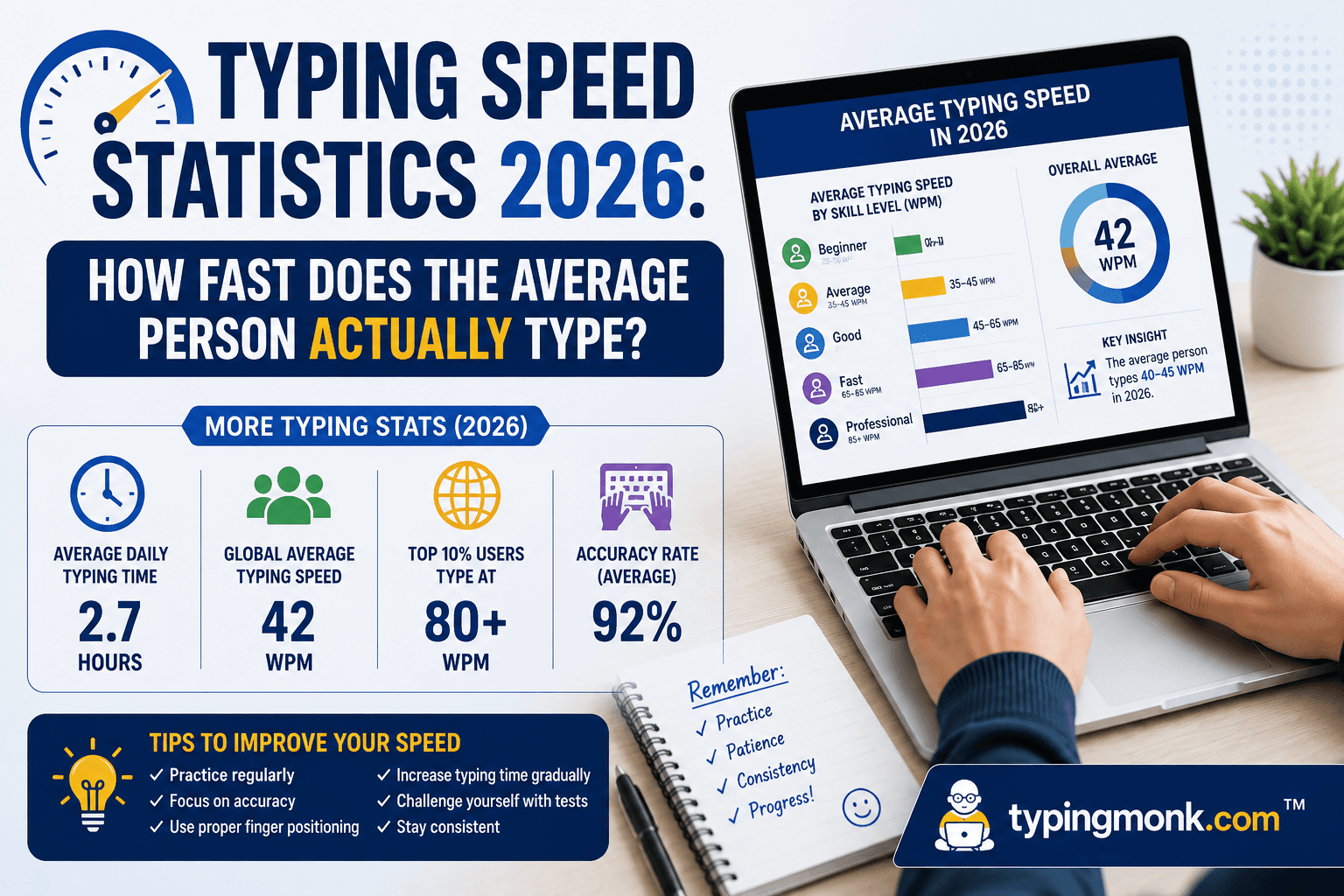
One of the most common questions people ask before taking a typing test is simple: how fast does the average person type? The answer in 2026, based on data from tens of millions of audited tests, is approximately 40 to 41.6 Words Per Minute (WPM).
a 2026 survey analyzing over 56,000 test-takers found average speeds clustering between 41 and 52 WPM depending on the testing methodology and platform. The 5-character-per-word standard (where a "word" equals any 5 characters including spaces) produces consistent averages across platforms, and the data consistently points to 40 WPM as the baseline for an untrained but computer-literate adult.
To put that in perspective: the average person speaks at 130 to 150 WPM. Typing at 40 WPM means the keyboard is roughly 3 to 4 times slower than spoken language. This gap is why voice dictation tools have grown in popularity, but for most professional work in 2026, keyboard typing remains the primary input method.
Typing Speed by Age Group
Age shows a clear relationship with typing speed, but not in the direction most people expect. Younger people are not necessarily the fastest typists.
Adults aged 25 to 40 (Millennials) average the highest speeds at approximately 55 to 56 WPM. This cohort grew up using computers through school and entered the workforce when typing-heavy communication (email, instant messaging, document creation) was already dominant. They have had two decades of high-volume daily typing practice.
Adults under 25 (Generation Z) average approximately 50 WPM. While this group grew up with smartphones, their primary text input was often touchscreen typing. PC keyboard usage is somewhat lower among this cohort than it was for Millennials at the same age.
Adults aged 40 to 55 (Generation X) average 45 to 50 WPM. This group learned to type in the personal computer era but spent their formative years in offices before instant messaging normalized constant typing.
Adults aged 55 and above (Baby Boomers) average 38 to 44 WPM. This group had the most exposure to typewriters before computers, and many learned typing formally — which explains why their speeds are not dramatically lower than younger cohorts despite less screen-centric daily life.
The data shows that consistent daily typing volume is a stronger predictor of speed than age. A 60-year-old who types extensively at work will frequently outperform a 22-year-old who primarily uses a phone.
Typing Speed by Profession
Professional category is the strongest predictor of typing speed, reflecting both the volume and type of typing required in different roles.
Legal professionals average approximately 60.6 WPM, making them the fastest professional category in aggregate data. Lawyers, paralegals, and legal assistants produce high volumes of precise, formal text with demanding deadline pressure.
IT and technology workers average 55 to 65 WPM. Programmers type large volumes of structured text with many special characters, building speed over time even though code typing involves frequent thinking pauses.
Writers and journalists average 60 to 70 WPM. Professional writing requires sustained high-volume text production, and experienced journalists routinely type at speeds well above 70 WPM when transcribing or drafting under deadline.
Administrative and clerical workers average 50 to 60 WPM. This category covers secretaries, executive assistants, receptionists, and office administrators whose daily work involves continuous document creation.
Customer service professionals average 45 to 55 WPM. Live chat support roles in particular demand above-average typing speed for maintaining acceptable response times.
Medical transcriptionists average 65 to 90 WPM. This is one of the highest-speed professional categories because transcription work requires sustained typing of complex medical terminology at the speed of playback audio.
General data entry workers average 40 to 50 WPM, though specialist data entry operators achieve 65 to 80 WPM through high-volume daily practice on standardized content.
Manufacturing and production workers, who type primarily for administrative tasks, average approximately 46 WPM — near the overall population average, reflecting occasional rather than intensive typing use.
Typing Speed by Country
Global data reveals interesting patterns across countries, though direct comparison is complicated by the fact that most global tests are conducted in English, which advantages native English speakers.
Nordic countries — Sweden, Finland, Norway, and Denmark — consistently produce the highest average typing speeds, with many surveys placing their averages above 50 WPM. Children in these countries begin typing in English-medium internet contexts from around age 5, creating two decades of bilingual typing experience by early adulthood.
The United States averages approximately 45 to 50 WPM across the general population, with significant variation by education level and profession.
India's urban, tech-savvy under-35 population averages above 50 WPM, driven by the large software industry and extensive use of English for professional communication. However, the broader Indian population typing average is lower when smaller cities and rural areas are included.
France consistently scores lower on global English typing tests, partly because the AZERTY keyboard layout used in France increases the travel distance for common English characters, creating inefficiencies for French users typing in English.
Japan shows high accuracy in Japanese language tests but lower WPM on English tests, reflecting the fundamental differences in how Japanese text is input (romaji-to-kana conversion systems versus direct key mapping).
How Remote Work Changed Typing Statistics
The shift to remote work since 2020 has had measurable effects on typing behavior and speed. People earning above $100,000 annually now spend approximately 87 percent of their working week typing — an increase from pre-pandemic norms.
Employees with higher typing proficiency demonstrate 15 to 20 percent higher task completion rates in finance, IT, and marketing roles, according to workforce productivity analysis conducted in 2024. The gap between fast and slow typists has become more consequential as typing-intensive communication (email, Slack, Zoom chat, document collaboration) replaced in-person interaction.
Remote workers who integrate AI writing assistance tools (autocomplete, grammar correction, AI drafting) report recovering 5 to 10 hours per week compared to those who type everything from scratch. However, these tools reduce net words typed rather than changing actual typing speed — the underlying motor skill remains as important as ever for the text that requires direct input.
The Gap Between Average and Professional Standards
For employment purposes, the definition of "good" typing speed varies by role. A receptionist position typically requires 40 WPM minimum. Data entry roles ask for 45 to 50 WPM as the floor. Transcription positions typically require 75 WPM or higher. Government clerk positions in India require 25 to 35 WPM depending on the exam.
The average person typing at 40 to 42 WPM is therefore right at the floor of what office employers consider minimum competency. Moving from average to genuinely productive (60 to 70 WPM) requires dedicated practice but is achievable for most adults within 2 to 3 months.
Accuracy Is Often More Important Than Raw Speed
Raw WPM figures tell only part of the story. Accuracy — the percentage of characters typed correctly — is an equally critical metric for most professional applications.
At 95 percent accuracy, a typist doing 60 gross WPM produces 57 net WPM after error deductions. At 80 percent accuracy, the same 60 gross WPM produces only 48 net WPM. The accuracy penalty for careless typing is substantial.
Professional typing standards in 2026 generally define competent typing as 50 to 60 WPM at 97 percent accuracy or above. Many employers screening for typing roles evaluate net WPM (accuracy-adjusted) rather than gross speed, making accuracy as important as raw speed.
Speed Distribution: Where Do You Fit?
Based on aggregate 2026 data, the approximate distribution of typing speeds among computer-literate adults is:
Under 30 WPM: Approximately 15 percent of people. This range is associated with hunt-and-peck typists or those with very limited keyboard experience.
30 to 50 WPM: Approximately 50 percent of people. This is the broad average range, covering most casual to moderate computer users.
50 to 70 WPM: Approximately 25 percent of people. Above average, typical of regular office workers and people who type heavily for work or personal use.
70 to 90 WPM: Approximately 8 percent of people. Fast, professional-grade typing. Typical of experienced journalists, coders, and professional administrative workers.
90 to 120 WPM: Approximately 2 percent of people. Expert level, often associated with transcriptionists, speed typists, and highly experienced technical professionals.
Above 120 WPM: Under 1 percent of the population. Elite competitive or professional speeds.
How to Improve Beyond Average
Moving from the 40 WPM average to 60 or 70 WPM is the most impactful improvement most people can make. This range is achievable within 4 to 8 weeks of consistent daily practice (15 to 30 minutes per day).
The key insight from the data is that most people plateau at their current speed because they practice at that speed repeatedly rather than challenging themselves with higher targets. Deliberate practice — typing at slightly above your comfort speed, correcting technique when errors appear, and gradually increasing the target — produces consistent improvement. Casual daily typing without focused practice typically does not improve speed over time.
At TypingMonk, you can take free timed tests to find your current baseline, then track improvement over time. Knowing your precise WPM and accuracy gives you a specific target to work toward and clear evidence of progress as you practice.
Put it into practice
Take a free typing test and see your WPM right now.
Comments
Sign in to leave a comment.