The fastest typists in history
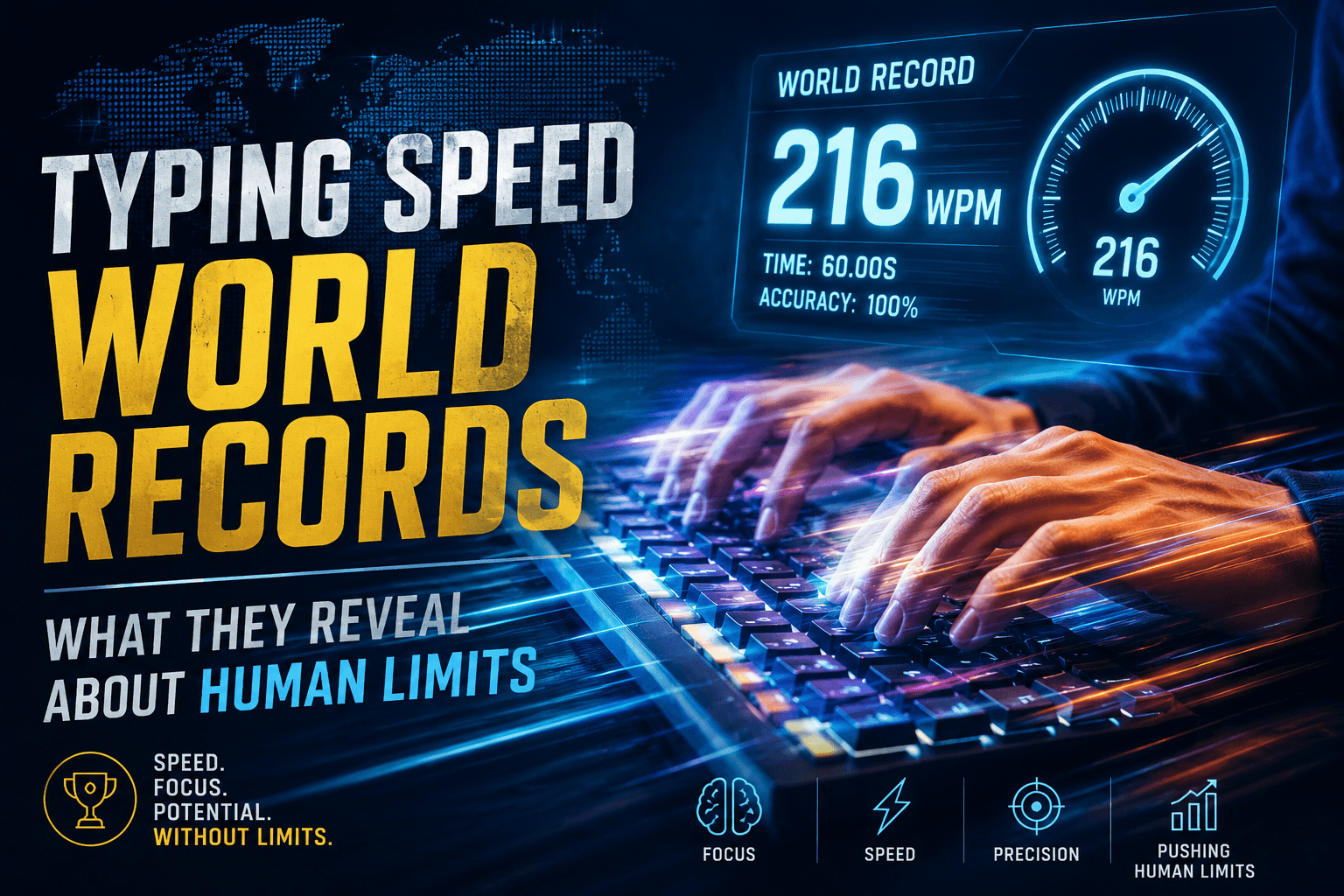
The world record for highest typing speed on a mechanical typewriter was held by Stella Pajunas-Garnand, who in 1946 typed 216 WPM on an IBM electric typewriter in a one-minute test. For decades this stood as the benchmark for the absolute upper limit of human typing speed. The shift to computer keyboards changed the landscape: the lower key resistance of electronic keyboards removed one physical bottleneck, enabling sustained speeds that mechanical typewriter mechanisms would have struggled to achieve.
On modern computer keyboards, speeds of 200+ WPM have been achieved in short bursts by a small number of practitioners. Barbara Blackburn, who died in 2008, was listed in the Guinness World Records at 212 WPM sustained for 50 minutes and a peak of 150 WPM for one minute on a Dvorak keyboard. More recently, competitive typing platforms like Typeracer and Monkeytype have recorded verified speeds of 230+ WPM in one-minute tests by practitioners such as Sean Wrona and Zhao Lei. These represent the very extreme of human motor performance.
What makes sub-100ms per keystroke possible
At 200 WPM, the average interval between keystrokes is approximately 60 milliseconds — roughly the same as a human blink. This challenges intuitive assumptions about the physical limits of finger movement. The key insight from motor neuroscience is that elite typists do not type sequentially — they pre-program movement sequences several keystrokes ahead and execute them in overlapping, parallel cascades rather than one at a time. The neural command for keystroke N+3 is being prepared while keystrokes N, N+1, and N+2 are still executing.
This parallel pre-programming is what makes the per-keystroke interval shorter than the time required for a single deliberate finger movement. The analogy is a pianist playing sixteenth notes at high tempo: they are not consciously deciding each note in sequence; they are executing a pre-compiled movement program at speed. Elite typists have similarly compiled the most common English words and phrases into movement programs that execute at speeds beyond conscious control.
The role of practice volume
Anders Ericsson's research on deliberate practice suggests that elite performance in most domains requires approximately 10,000 hours of focused, effortful practice. The top-ranked competitive typists typically report typing histories starting in childhood, daily keyboard use of many hours, and explicit competitive practice on typing platforms over years. The fastest practitioners on modern competitive typing platforms often report keyboard use since the age of seven or eight and a focus on competitive typing starting in their teenage years.
This does not mean that casual typists cannot reach impressive speeds — many people achieve 80–100 WPM through ordinary computer use without any deliberate typing practice. But the 150+ WPM range consistently requires deliberate practice volume and technique optimisation that goes well beyond normal keyboard use. The 10,000-hour estimate is useful as an order-of-magnitude guide to the commitment required for world-class performance.
Competitive typing communities
Online typing communities have grown significantly since the 2010s, with platforms like Typeracer (launched 2008), Nitrotype, and Monkeytype attracting communities of competitive typists who compete in real-time races and chase leaderboard rankings. These communities have produced a cohort of typists who achieve 120–180 WPM reliably — speeds that would have been considered exceptional even for professional typists a generation ago.
The competitive community has also produced innovations in keyboard hardware (custom mechanical keyboards with specific switch weights and key cap profiles optimized for typing speed rather than gaming or office use) and training methodology (short-burst tests on specific word lists rather than general prose, targeted practice on weak letter combinations, audio monitoring of keystroke rhythms). This specialized ecosystem produces WPM figures that illustrate what human typing can achieve with dedicated optimisation.
What records mean for ordinary typists
World records are interesting as upper-bound benchmarks but have limited practical relevance for most professional typists. The functional sweet spot — fast enough to keep up with thought, accurate enough to avoid editing burden, sustainable for a full working day — sits in the 60–90 WPM range for most knowledge workers. Reaching 80 WPM on a 5-minute test is achievable for most adults with deliberate practice over several months and represents a meaningful productivity advantage over average speeds.
The more relevant takeaway from the study of exceptional typists is methodological: the importance of deliberate practice, technique precision, chunking through high-volume repetition of common words, and ergonomic setup. These principles apply equally to a typist moving from 30 WPM to 50 WPM and to one moving from 80 WPM to 100 WPM. The mechanisms are the same; only the practice volume and technique refinement required differ.
Put it into practice
Take a free typing test and see your WPM right now.
Comments
Sign in to leave a comment.