The history of the 5-minute test
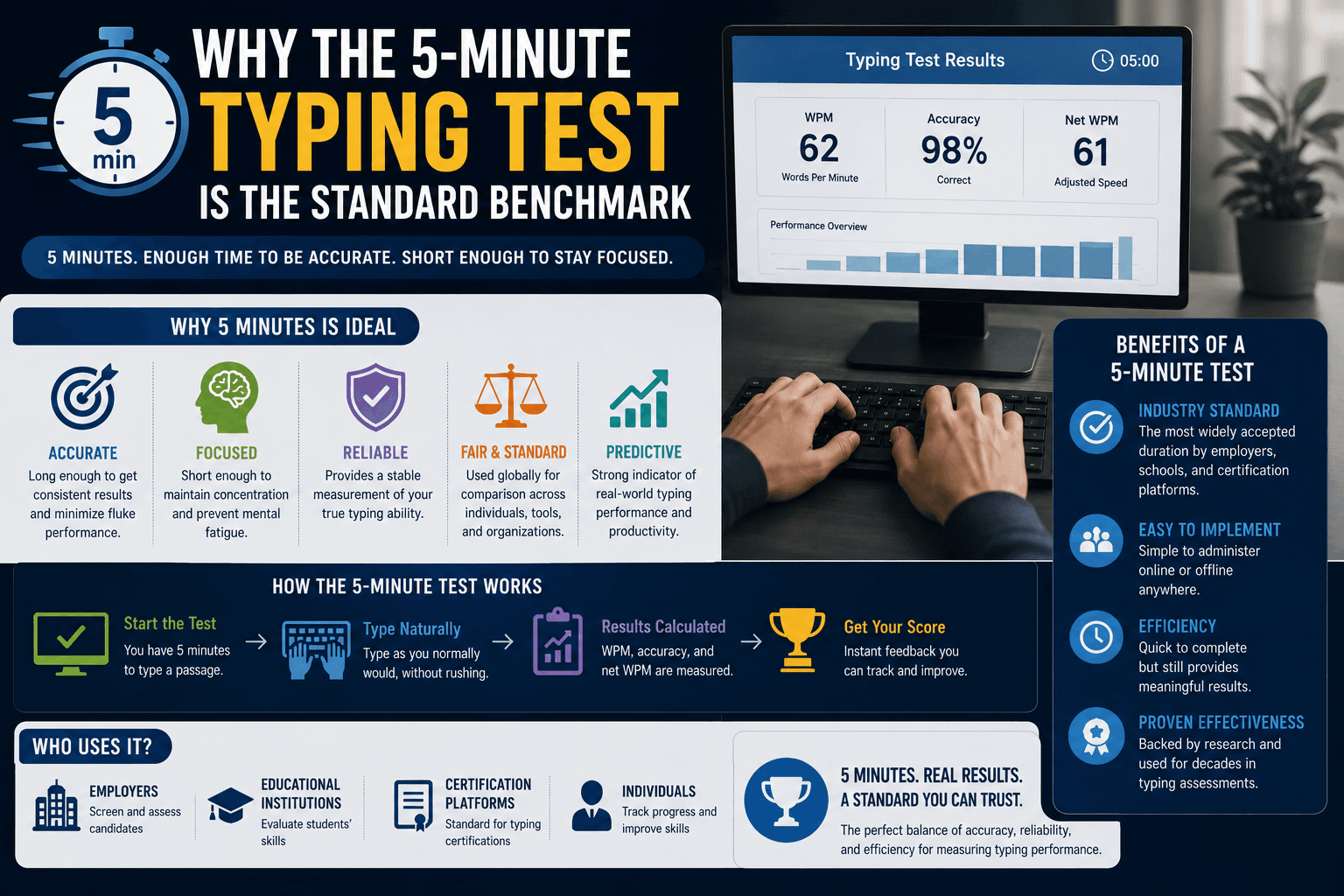
The five-minute typing test became the standard employment benchmark in the early twentieth century when typing speed was a primary hiring criterion for secretarial and clerical roles. Standardisation bodies and government agencies found that one minute produced too much variance — a typist could have an unusually good or bad minute that did not represent their sustained capability. Ten minutes was considered too long for a hiring screen. Five minutes consistently gave assessors a reliable picture of practical typing speed with manageable assessment time.
That convention has persisted into the digital age. Most professional typing certification programs, government civil service assessments, and employment screening platforms use five minutes as their primary test duration. The underlying reason remains valid: five minutes is long enough to measure sustained performance, short enough to be practical as a screening tool, and well enough established that comparison across time and contexts is meaningful.
What exactly the 5-minute test measures
In a 1-minute test, the main factor is peak burst speed — how fast you can type when fresh, focused, and before any fatigue sets in. The score is highly variable; a single momentary distraction or unusual word cluster can shift the result by 5–10 WPM. In a 5-minute test, the initial burst contributes only 20% of the score. Minutes 2–5 measure sustained typing speed, which is what you actually deliver in real working conditions. The test also captures how your speed and accuracy behave as your concentration is maintained over a longer period.
Research in human factors consistently shows that performance in the first minute of a typing test is a poor predictor of five-minute performance. Some typists who start fast fatigue and drop significantly; others who start slow warm up and improve. The 5-minute measurement averages these patterns into a stable, representative score. This is why employers specifically use five minutes rather than one.
1-minute vs 3-minute vs 5-minute: when to use each
1-minute tests are ideal for daily warm-ups, quick progress checks, or moments when you want to test your peak speed under ideal conditions. They are not reliable benchmarks for employment purposes or for comparing your progress week to week because the variance is too high. Use the 1-minute test to start each practice session and to experiment with speed without commitment.
3-minute tests offer a middle ground that many typists find ideal for regular practice. They are long enough to smooth out the initial adrenaline burst, short enough to complete several in a row, and give a more stable WPM figure than 1-minute tests. Use 3-minute tests for the bulk of your regular practice. 5-minute tests are your benchmarks — take one at the end of each week to track your actual progress and to practice under conditions that match the employment standard.
Longer tests: 10, 15, and 30 minutes
Tests longer than five minutes serve a specific purpose: building and demonstrating typing endurance. Medical transcriptionists, legal secretaries, data entry operators in high-volume environments, and anyone whose job involves continuous typing for hours at a time benefit from regular long-form test practice. Endurance training reveals different weaknesses than speed practice — posture issues, wrist fatigue, and concentration lapses that do not show up in five-minute tests.
TypingMonk offers test durations up to 60 minutes for exactly this purpose. If you are preparing for a role that involves sustained typing — not just a hiring test but the actual job — running weekly 15- or 30-minute sessions will develop endurance that short-test practice alone cannot build. Start with 10-minute tests and work up to longer durations over several weeks rather than jumping directly to 30 or 60 minutes.
How to get a reliable 5-minute score
A single 5-minute test is not your true benchmark — it is a data point. Environmental factors, focus level, the specific vocabulary in the passage, and hour-of-day effects can each shift a result by several WPM. For a reliable benchmark, take three 5-minute tests on different days at the same time of day, then take the middle result (or average the three). This accounts for random variance and gives you a number you can genuinely compare across weeks.
Take the tests under controlled conditions: the same keyboard, the same seating position, no background conversation, adequate sleep the night before. The point is not to optimize for one heroic result but to measure your reliable everyday performance — the WPM figure you can sustain without unusual preparation. That is the number that matters for employment assessments and for tracking your genuine improvement.
Setting goals with the 5-minute test
Use your current 5-minute benchmark as the baseline for goal-setting. A realistic incremental target is 5–8 WPM above your current benchmark, achievable within four to six weeks of consistent practice. When you hit that target on three separate occasions, it becomes your new baseline and you set the next 5 WPM increment. This incremental approach prevents the frustration of setting an unrealistically distant goal and the loss of motivation when it does not come quickly.
For employment preparation specifically: if the job requires 60 WPM, set your practice target at 65–70 WPM. The slight buffer accounts for test-day nerves, an unfamiliar keyboard, and the slightly different text format of an employer's assessment platform. Arriving at a 60 WPM requirement with a reliable 67 WPM benchmark puts you in a comfortable position rather than at the edge of qualification.
Put it into practice
Take a free typing test and see your WPM right now.
Comments
Sign in to leave a comment.