Why Typing Speed Has Multiple Metrics
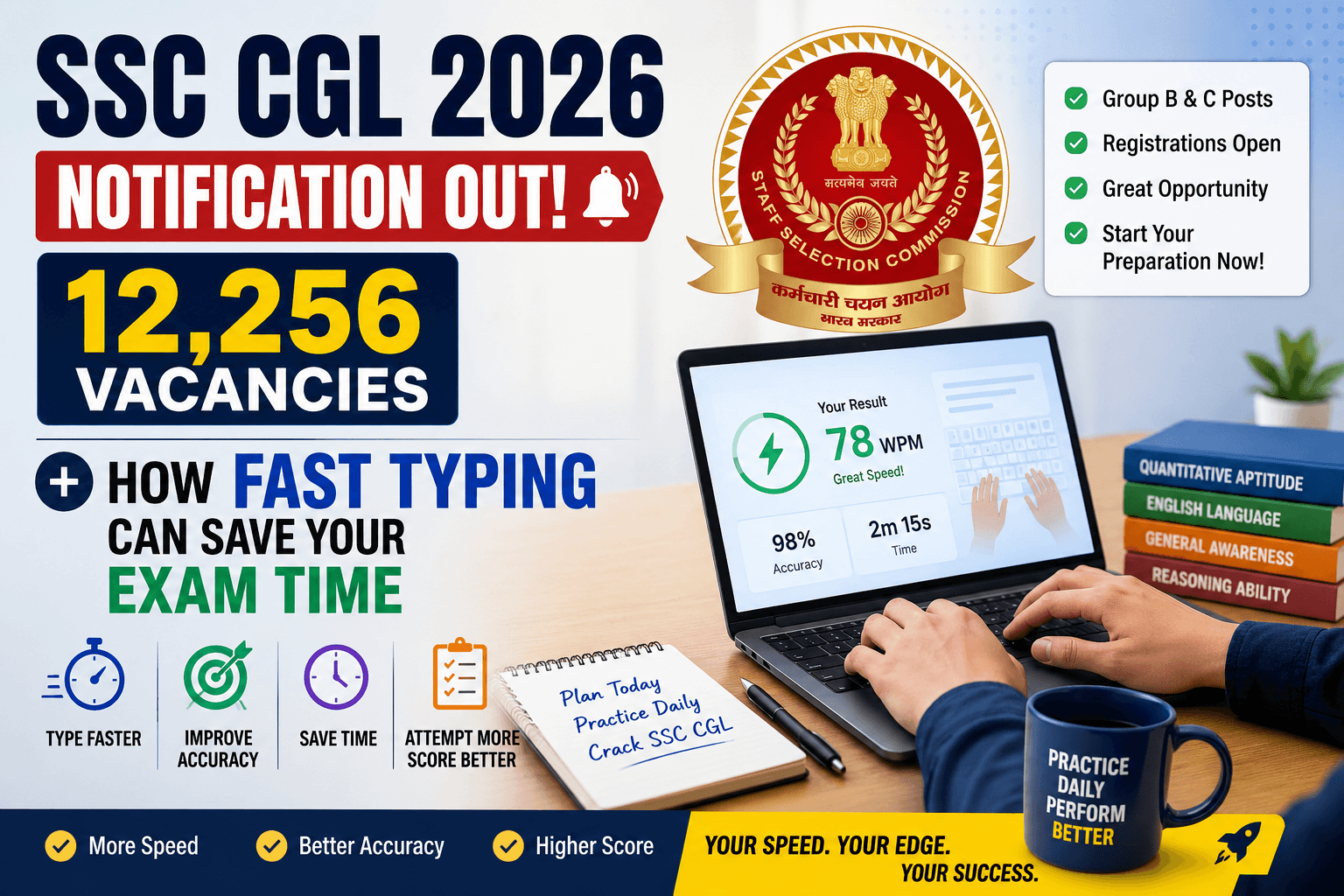
If you are preparing for a government typing test in India, you have probably seen different exams specify typing speed in different ways. SSC CHSL asks for 35 WPM. Some sources describe the same requirement as 10,500 KDPH. CPCT specifies 30 NWPM. RRB uses phrases like "300 words in 10 minutes." Are these all the same thing? Why do different exams use different metrics?
The confusion is understandable and widespread. Multiple typing speed metrics exist because different contexts care about different aspects of typing performance. This guide explains each metric clearly, shows the mathematical relationship between them, and tells you exactly how each major Indian government exam uses them.
The Basic Unit: What Is a "Word" in Typing?
The most important thing to understand about typing speed measurement is that a "word" in typing tests is not a dictionary word. It is a standardized unit of five characters.
This 5-character-per-word definition was established in the mechanical typewriter era as a way to create consistent speed measurement regardless of which actual words appear in a passage. A passage full of short words (like "I am at the top of my game") would give inflated WPM if every space-separated string counted as one word, while a passage full of long words would give deflated WPM. The 5-character standard normalizes for this.
Example: The sentence "The quick brown fox jumps" contains 5 words (dictionary words) and 24 characters including spaces. In typing measurement: 24 ÷ 5 = 4.8 typing "words." The sentence counts as 4.8 WPM if typed in one minute.
This definition applies universally across all major typing tests and is the basis for WPM, NWPM, and KDPH calculations.
Gross WPM: The Raw Speed
Gross WPM is the total number of typing "words" (5-character units) you type in a given time period, regardless of errors.
Formula: Gross WPM = (Total characters typed ÷ 5) ÷ minutes elapsed
Example: In a 10-minute SSC test, you type 2,100 characters. Gross WPM = (2,100 ÷ 5) ÷ 10 = 420 ÷ 10 = 42 WPM.
Gross WPM does not reflect errors. It is the "before penalties" speed. Most exam contexts require net WPM, not gross, for qualifying. Gross WPM is useful as a starting point for error deduction calculations.
Net WPM: What Actually Counts
Net WPM (also written NWPM) is the speed after deducting errors from the gross count. This is the number that determines whether you pass or fail a typing test.
The simplest net WPM formula: Net WPM = Gross WPM − error deductions.
But different exams calculate error deductions differently, which is why the same underlying typing performance can produce different net WPM results under different exam rules.
How SSC Calculates Net WPM
SSC CHSL and CGL use a full-mistake and half-mistake system.
A Full Mistake deducts 1 word from gross. It occurs when you type a completely wrong word, omit a word, or add an extra word.
A Half Mistake deducts 0.5 words from gross. It occurs when you type the correct word but with a spacing error, capitalization error, or punctuation error.
Formula: Net WPM = [(Total characters typed ÷ 5) − full mistakes − (half mistakes × 0.5)] ÷ minutes elapsed
Worked example: - Characters typed in 10 minutes: 2,150 (Gross WPM = 43) - Full mistakes: 10 - Half mistakes: 14 - Deduction: 10 + (14 × 0.5) = 10 + 7 = 17 words - Net words: 430 − 17 = 413 - Net WPM: 413 ÷ 10 = 41.3 - Requirement: 35 WPM. Result: Pass.
SSC also applies an error tolerance grace that varies by category (20% for General, 25% for OBC/EWS, 30% for SC/ST) measured as a percentage of total characters in the passage.
How RRB NTPC Calculates Net WPM
RRB uses the same full/half mistake system but adds a 5 percent grace window. The first 5 percent of total typed words are protected from error deductions. Errors beyond this grace threshold are deducted using the full/half mistake system.
Worked example: - Words typed in 10 minutes: 340 (Gross WPM = 34) - 5% grace: 340 × 0.05 = 17 grace words - Full mistakes: 8 - Half mistakes: 12 - Total deduction equivalent: 8 + (12 × 0.5) = 8 + 6 = 14 - Grace covers 14 (grace = 17, deduction = 14, so 14 < 17) - Net WPM: 34 (no deductions beyond grace) - Requirement: 30 WPM. Result: Pass with margin.
Revised example with higher errors: - Words typed: 340 - Full mistakes: 20 - Half mistakes: 18 - Total deduction: 20 + 9 = 29 - Grace covers 17; effective deduction: 29 − 17 = 12 words - Net words: 340 − 12 = 328 - Net WPM: 32.8. Requirement: 30 WPM. Result: Pass — barely.
How CPCT Calculates Net WPM
CPCT (Madhya Pradesh) uses a simpler system: backspace is allowed, so you can correct errors in real time. Net WPM is calculated as the total correct words typed divided by minutes. Words left in error (not corrected before the test ends) are excluded from the count.
This means CPCT's net WPM is literally: words that are correct in the final text ÷ minutes. No separate error deduction formula is needed because errors either get corrected (and count) or remain (and do not count).
For CPCT: Net WPM = Correct words in final typed text ÷ minutes
Worked example: - You type for 15 minutes and finish with 480 correct words in the final text. - NWPM = 480 ÷ 15 = 32 NWPM - Requirement: 30 NWPM. Result: Pass.
KDPH: Key Depressions Per Hour
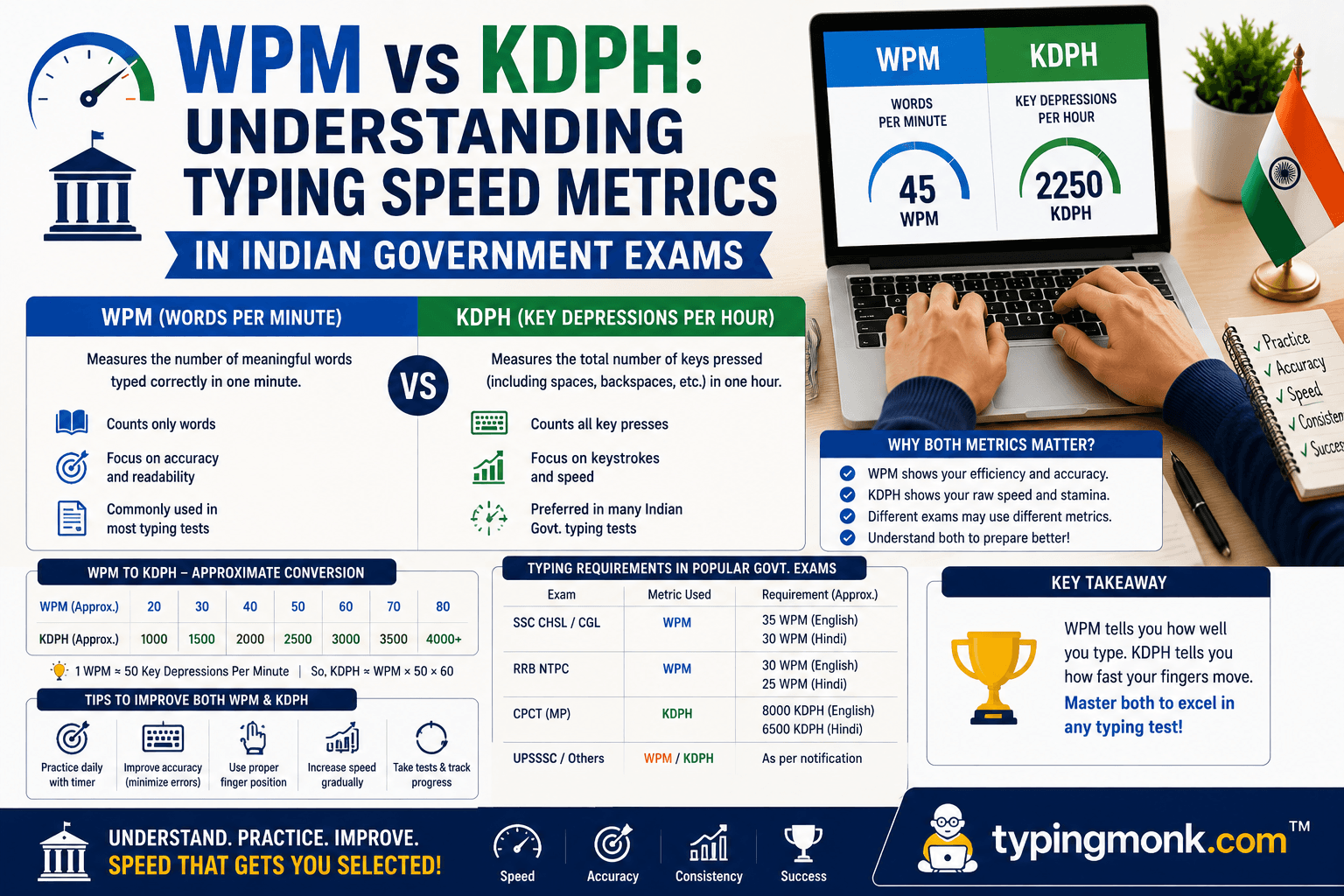
KDPH (Key Depressions Per Hour) is an alternative metric that some exam specifications and coaching materials use instead of WPM. It measures the total number of individual key presses per hour.
The relationship between WPM and KDPH is straightforward: KDPH = WPM × 5 characters per word × 60 minutes per hour
So: 35 WPM × 5 × 60 = 10,500 KDPH. This is exactly why SSC describes its English requirement as both "35 WPM" and "10,500 KDPH" — they are the same speed.
Verification: - 30 WPM = 30 × 5 × 60 = 9,000 KDPH (SSC Hindi requirement) - 25 WPM = 25 × 5 × 60 = 7,500 KDPH (RRB Hindi requirement) - 30 WPM = 30 × 5 × 60 = 9,000 KDPH (RRB English) — but RRB specifies 30 WPM not KDPH
KDPH appears most commonly in older exam documents and coaching materials from the typewriter era, when counting physical key depressions was easier than converting to words. Modern exam notifications increasingly use WPM, but KDPH references still appear frequently in study materials and state-level exam documents.
Converting Between Metrics
Quick reference conversion table for common exam requirements:
25 WPM = 7,500 KDPH = 250 words in 10 minutes 30 WPM = 9,000 KDPH = 300 words in 10 minutes 35 WPM = 10,500 KDPH = 350 words in 10 minutes 40 WPM = 12,000 KDPH = 400 words in 10 minutes 45 WPM = 13,500 KDPH = 450 words in 10 minutes
For CPCT (NWPM): the threshold of 30 NWPM in 15 minutes means you need 450 correct words in the 15-minute test. At 20 NWPM for Hindi: 300 correct Hindi words in 15 minutes.
Accuracy Percentage and Its Relationship to Net WPM
Accuracy percentage is calculated as: (Net WPM ÷ Gross WPM) × 100.
At different accuracy levels, your net WPM at a given gross speed changes dramatically:
100% accuracy: Net WPM = Gross WPM (no deductions) 98% accuracy: Net WPM ≈ Gross WPM − 2% 95% accuracy: Net WPM ≈ Gross WPM − 5% 90% accuracy: Net WPM ≈ Gross WPM − 10% 80% accuracy: Net WPM ≈ Gross WPM − 20%
For the SSC requirement of 35 Net WPM: if you type at 95% accuracy, you need approximately 37 Gross WPM. At 90% accuracy, you need approximately 39 Gross WPM. At 80% accuracy, you need approximately 44 Gross WPM.
This is why accuracy and speed are inseparable. Improving accuracy from 85% to 95% while keeping gross speed constant is equivalent to gaining approximately 4 to 5 WPM of net speed.
Practical Implications for Exam Preparation
Understanding these metrics changes how you should practice. Rather than just aiming to hit the minimum net WPM on the day, build a practice target that accounts for exam-day performance drop.
Most candidates type 5 to 10 WPM slower in actual exams than in practice due to stress, unfamiliar passage content, and the psychological weight of the stakes. A candidate whose consistent practice speed is exactly 35 WPM will often fail an SSC exam because of this drop.
Practical targets for practice: - SSC CHSL English (35 WPM required): Practice target 42 to 45 WPM - SSC CHSL Hindi (30 WPM required): Practice target 36 to 40 WPM - RRB NTPC English (30 WPM required): Practice target 36 to 40 WPM - CPCT English (30 NWPM required): Practice target 36 to 40 NWPM - CPCT Hindi (20 NWPM required): Practice target 25 to 28 NWPM
In practice sessions, track both gross WPM and net WPM with error reporting. If your net is significantly below your gross — say, gross 42 WPM and net 34 WPM — your error rate is the bottleneck, not your raw speed. In that case, slow down slightly in practice, focus on accuracy, and let speed follow from technique.
The relationship between all these metrics is simple arithmetic, but understanding it clearly is the difference between knowing your exam requirements and actually preparing to meet them with confidence.
Put it into practice
Take a free typing test and see your WPM right now.
Comments
Sign in to leave a comment.